

flux wins this comparison
The AI image generation landscape has evolved dramatically in 2025, with two powerhouse models dominating professional workflows: Midjourney V7 and Flux 2. Released just seven months apart—Midjourney V7 in April and Flux 2 in late November—these tools represent fundamentally different philosophies. Midjourney doubles down on artistic interpretation and user-friendly access, while Flux 2 delivers unprecedented technical precision and flexibility.
This comparison examines how these latest versions stack up across the metrics that matter most to creators, developers, and businesses.
Overview: Two Visions for AI Image Generation
Midjourney V7 emerged as the default model on June 17, 2025, building on its reputation as the creative professional’s choice. The platform maintains its signature Discord-based workflow while expanding into web interfaces and experimental video generation. Version 7 introduced a redesigned architecture with updated datasets, delivering 20-30% faster rendering (up to 40% in specific contexts) and enhanced prompt interpretation that understands multi-step instructions and emotional context.
Flux 2, launched November 24-25, 2025, by Black Forest Labs, takes a radically different approach. Available in three distinct variants—[dev], [pro], and [flex]—it offers everything from a 32-billion-parameter open-weight model for custom training to optimized API endpoints for production use. Its multi-reference capability supports up to 10 input images, solving the persistent “stochastic drift” problem that has plagued character consistency in AI art.
Feature Comparison: Capabilities and Technical Specifications
Core Architecture and Performance
Midjourney V7 operates as a closed, cloud-only system with proprietary architecture. It renders images approximately 40% faster than its predecessor, with most generations completing in under a minute. The system supports resolutions beyond the 1024×1024 limit of V6, though exact specifications continue to evolve.
Flux 2 offers more transparent technical specifications. The [dev] variant packs 32 billion parameters and can run locally on high-VRAM GPUs (an RTX 4090 generates a 1024x1024 image at 50 steps in about 15-20 seconds). The [pro] and [flex] models deliver sub-10-second generation times via API, with maximum outputs reaching 4 megapixels at any aspect ratio. A 32K token context window allows for extraordinarily detailed prompts.
Interface and Accessibility
Midjourney’s greatest strength remains its frictionless user experience. The Discord integration and polished web interface require no technical setup. Users can begin creating immediately with intuitive commands and a vibrant community for inspiration and support.
Flux 2 demands more technical literacy. The [dev] model requires local GPU setup and command-line interaction, while API usage necessitates familiarity with platforms like Replicate, Together AI, or Kie.ai. This complexity creates a steeper learning curve but rewards users with granular control.
Unique Capabilities
Midjourney V7 introduces several workflow innovations:
- Draft Mode: Generates images 10x faster at half cost for rapid ideation
- Omni Reference: Advanced image referencing beyond simple style transfer
- Voice Mode: Conversational prompting for hands-free operation
- NeRF-like 3D: Creates explorable 3D scenes from text descriptions
- Video Generation: Early-stage capability producing 60 seconds of video from six images in roughly three hours
Flux 2 focuses on production-grade precision:
- Multi-Reference Generation: Maintains character consistency across up to 10 input images
- Hex Code Matching: Ensures exact brand color compliance
- Three Model Variants: Tailored for development, production, or typography-heavy work
- Full Fine-Tuning: Available on the [dev] model for custom training
- Output Ownership: Complete commercial rights without subscription dependencies
Quality Comparison: Where Each Model Excels
Photorealism and Artistic Interpretation
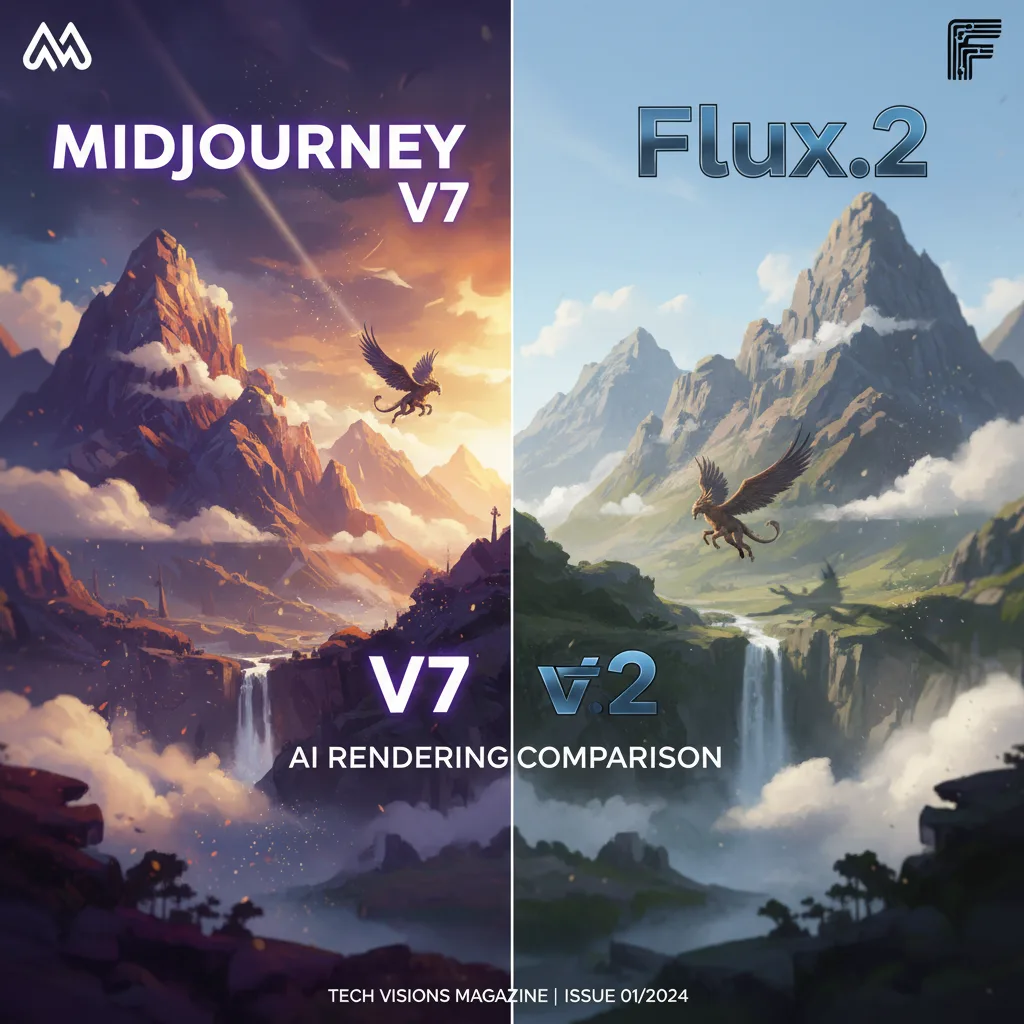
Midjourney V7 produces images with its signature cinematic polish—colors that pop, dramatic lighting, and compositions that feel deliberately stylized. It transforms reality into expressive digital painting, making it ideal for concept art and marketing visuals that need immediate aesthetic impact.
Flux 2 employs physics-based rendering that yields lifelike lighting, accurate shadows, and realistic depth perception. Materials like fabric, metal, and glass render with technical accuracy. While perhaps less “magical” than Midjourney’s output, Flux 2’s photorealism serves product photography and architectural visualization better.
Text Rendering and Typography
This is Flux 2’s most decisive victory. Users report generating readable text on first attempts, with one creator noting they “made a fake movie poster with title text that was 100% readable. First try. Almost cried.” The [flex] variant specifically optimizes for UI elements, infographics, and typography-heavy content.
Midjourney V7 improved text rendering significantly over V6, but remains inconsistent. While it can handle simple typography on posters, longer text passages or complex layouts often produce artifacts and legibility issues.
Character Consistency and Multi-Reference
Flux 2’s multi-reference system represents a fundamental leap in architecture. By accepting up to 10 reference images, it solves the persistent problem of character morphing between generations. This makes it invaluable for comic book artists, brand mascots, and serialized storytelling.
Midjourney V7’s --cref parameter offers good single-character consistency but cannot match Flux’s multi-image capability. For projects requiring tight continuity, Flux holds a clear advantage.
Anatomy and Detail Fidelity
Both models excel at human anatomy compared to earlier generations. Midjourney V7 perfected hand rendering, accurately depicting complex poses like yoga positions or guitar playing. However, it still struggles with background faces in crowded scenes.
Flux 2 demonstrates excellent hand and face rendering across the board, with robust detail preservation at higher resolutions. Its physical-world understanding extends to accurate object interactions and spatial relationships.
Prompt Adherence
Flux 2 demonstrates superior precision in following detailed instructions, likely due to its 32K token context window. Complex prompts with multiple constraints—camera specifications, lighting conditions, compositional rules—execute with technical accuracy.
Midjourney V7 interprets prompts more artistically, sometimes deviating from specifications to produce aesthetically pleasing results. This can frustrate users needing exact compliance but delights those seeking creative surprises. For those looking to improve their prompting skills, our complete AI image prompting guide covers advanced techniques for both platforms.
Pricing: Subscription vs. Flexible Models
Midjourney V7 Pricing
Midjourney maintains a subscription-only model with no free tier as of 2025:
- Basic: $10/month (~200 generations or 3.3 fast hours)
- Standard: $30/month (15 fast hours, unlimited relaxed mode)
- Pro: $60/month (30 fast hours, stealth mode, 12 concurrent jobs)
- Mega: $120/month (60+ fast hours, priority support)
Annual subscriptions offer 20% savings. Additional fast GPU time can be purchased separately, and Draft Mode reduces costs by 50% for exploratory work.
Flux 2 Pricing
Flux 2 offers unprecedented pricing flexibility through multiple access points:
Official Flux Labs Platform: Pricing should be verified directly from official sources as third-party implementations vary.
- Free Tier: 40 credits for new users plus 20 daily check-in credits
- Common Plan: $7.99/month yearly (5,000 credits)
- Popular Plan: $15.99/month yearly (13,000 credits)
- Pro Plan: $23.99/month yearly (21,000 credits)
- One-Time Purchases: $9.99 for 4,000 credits or $19.99 for 10,000 credits
Third-Party API Pricing: Rates vary by provider and are not official Black Forest Labs pricing.
- FLUX.2 [pro]: $0.03 per megapixel + $0.015 per additional megapixel
- FLUX.2 [flex]: $0.07-$0.12 per 1K resolution image
- Replicate API: $0.015 base + $0.015 per input/output megapixel
- Kie.ai: 5 credits (
$0.025) for 1K, 7 credits ($0.035) for 2K
This model allows users to pay only for what they need, making Flux 2 accessible to hobbyists while scaling cost-effectively for enterprises.
Use Cases: Matching Tools to Workflows
When to Choose Midjourney V7
Creative Professionals and Artists
- Concept artists needing rapid visual exploration
- Illustrators seeking expressive, painterly aesthetics
- Art directors developing campaign visuals with cinematic flair
Marketing and Advertising
- Social media content requiring immediate visual impact
- Brand campaigns prioritizing stylized interpretation over literal accuracy
- Agencies benefiting from Discord-based team collaboration
Video and Motion Content
- Early adopters experimenting with AI video generation
- Storyboard artists leveraging 3D scene generation
- Creators needing 60-second video clips from static images
Casual Users and Beginners
- Those prioritizing ease of use over technical control
- Users without GPU hardware or API experience
- Community-driven creators seeking inspiration and feedback
When to Choose Flux 2
Product and E-commerce Photography
- Brands requiring consistent product visualization across campaigns
- E-commerce platforms generating catalog images at scale
- Photographers needing rapid prototyping of lighting setups
Character Design and Storytelling
- Comic book artists maintaining character consistency across panels
- Game developers generating asset libraries for NPCs
- Animators creating reference sheets for 3D modeling
Brand Identity and UI Design
- Designers needing exact hex code color matching
- Agencies creating typography-heavy mockups and infographics
- Developers generating UI assets with readable text
Technical Teams and Developers
- Applications requiring API integration and custom workflows
- Researchers fine-tuning models on proprietary datasets
- Organizations needing full output ownership without licensing concerns
Budget-Conscious Power Users
- Creators generating high volumes of images cost-effectively
- Startups scaling visual content without enterprise subscriptions
- Hobbyists wanting professional capabilities with free tier access
Verdict: Flux 2 Wins on Overall Value
After evaluating both tools across six critical dimensions, Flux 2 emerges as the winner for overall value, though the decision hinges on your specific priorities.
Why Flux 2 Wins
Pricing Flexibility: Flux’s hybrid model—offering free credits, affordable subscriptions, and pay-per-image APIs—makes professional AI generation accessible at any scale. Midjourney’s subscription-only approach creates a $120/month barrier for power users and offers no free tier for experimentation.
Technical Superiority: Multi-reference consistency, best-in-class text rendering, hex code precision, and 4MP resolution give Flux 2 a decisive edge for production workflows. These aren’t incremental improvements; they solve fundamental problems that have limited AI adoption in professional pipelines.
Ownership and Control: Full commercial rights without subscription dependencies, combined with the open-weight [dev] model for custom training, position Flux 2 as the enterprise-grade solution. Midjourney’s output ownership remains tied to active subscriptions.
Future-Proof Architecture: The three-variant approach—[dev] for research, [pro] for production, [flex] for specialization—creates a sustainable ecosystem that serves everyone from indie developers to Fortune 500 companies.
Where Midjourney V7 Still Reigns
For creative professionals who prioritize artistic interpretation over technical precision, Midjourney V7 remains unmatched. Its ability to transform mundane prompts into visually stunning, emotionally resonant artwork justifies its subscription cost for concept artists, illustrators, and marketing creatives. The Discord community and intuitive interface lower the barrier to entry dramatically, making it the clear choice for those who want to create, not configure.
The emerging video generation capabilities, while early-stage, suggest Midjourney is betting on becoming an all-in-one creative suite rather than a specialized image generator.
The Bottom Line
Choose Flux 2 if you need:
- Character consistency across multiple generations
- Readable text and typography in images
- Flexible pricing that scales with usage
- Full commercial ownership without subscriptions
- API integration or local deployment
- Technical precision over artistic interpretation
Choose Midjourney V7 if you need:
- Immediate, stunning artistic results with minimal effort
- A community-driven creative environment
- Cinematic, stylized visuals out of the box
- Emerging video generation capabilities
- An intuitive interface that requires zero technical setup
Flux 2’s combination of technical innovation, pricing flexibility, and production-ready features makes it the more versatile and valuable tool for 2025’s diverse creator economy. However, the ideal toolkit might include both: Flux 2 for client work requiring precision and ownership, Midjourney V7 for creative exploration and artistic inspiration.
For those interested in exploring other options, check out our comprehensive guide to the best AI image generators in 2025 or learn about budget-friendly alternatives. You can also read our detailed Midjourney V6 review to understand how the platform has evolved, or explore our comparison between Flux and Stable Diffusion 3.5 for additional context on the competitive landscape.