
Recraft wins this comparison
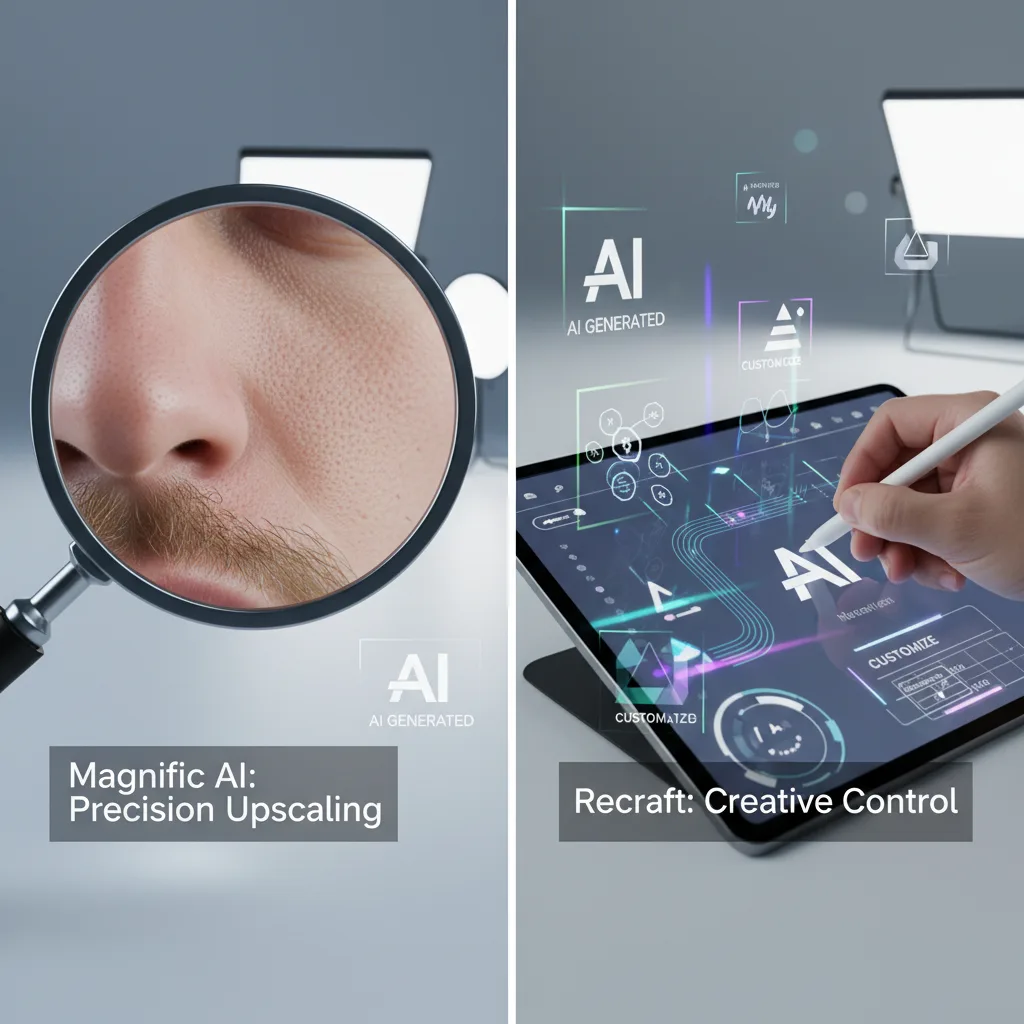
The AI image enhancement landscape has fractured into two distinct philosophies: tools that perfect what exists, and tools that reimagine what’s possible. On one side stands Magnific AI, the precision upscaler prized by photographers for its ability to breathe high-resolution life into every pixel. On the other, Recraft has emerged as the designer’s playground, blending generation and editing in a canvas-based workflow that puts human creativity back in command.
As we close out 2025, choosing between these tools isn’t about finding the “best” AI image processor—it’s about aligning technology with your creative DNA. Are you restoring archival photography or building brand identities? Enhancing reality or orchestrating it? This comparison cuts through the marketing fog to reveal which tool deserves your workflow.
The Contenders at a Glance
Magnific AI built its reputation on surgical image enhancement. Developed by Javi Lopez and Emilio Nicolas (acquired by Freepik in May 2024), this web-based platform uses convolutional neural networks trained on millions of paired low and high-resolution images. Its specialty is generative upscaling that adds natural detail while preserving photographic integrity—skin pores remain skin pores, just sharper and more defined.
Recraft took a different path, launching its V3 model (famously teased as “Red Panda”) with a clear mission: restore creative control to AI image generation. Rather than one-shot prompting, Recraft provides a Photoshop-like canvas where users erase, lasso, layer, and refine. It generates both raster images and true vector SVGs, making it the only platform architected from the ground up for professional design workflows.
Upscaling Quality: Precision vs. Interpretation
When tested on portrait photography, Magnific AI demonstrates exceptional fidelity. Fine elements like individual hair strands, jewelry textures, and fabric weaves snap into focus without the over-sharpened halos that plague lesser tools. The platform’s “Precision” mode caps at 2x enlargement but delivers remarkable detail preservation, maintaining color accuracy and avoiding the plastic, over-processed look that affects aggressive competitors. For photographers restoring soft images or preparing prints, Magnific’s restraint is its strength.
Recraft approaches upscaling as one feature within a broader creative suite. While its V3 model generates impressive initial images, its upscaling capabilities are more interpretive. The platform excels at adding bold enhancements and creative details, but this aggression comes at a cost—testing reveals it can stray significantly from the source material. For brand assets where consistency is paramount, this unpredictability creates workflow friction. However, for marketing visuals where impact trumps pixel-perfect accuracy, Recraft’s enhancements often look more striking at first glance.
The critical difference emerges in handling low-resolution sources. Magnific’s deep learning models predict missing details with photographic realism, while Recraft’s generative approach sometimes invents textures that, while visually pleasing, may not reflect reality. For a 275px portrait, Magnific produces a faithful enlargement; Recraft might generate sharper—but potentially inaccurate—facial features.
Creative Control: The Canvas Revolution
This is where Recraft fundamentally diverges from Magnific’s philosophy. Recraft’s canvas interface transforms AI image generation from a dice roll into a deliberate creative process. Users can:
- Erase unwanted elements with a single click, replacing them with seamless AI-generated backgrounds
- Lasso specific regions and prompt for precise additions (“add the missing wheel well,” “place a flying saucer here”)
- Integrate real photography with AI imagery, automatically removing backgrounds and adjusting color palettes
- Add typography using a dedicated text tool that blends seamlessly with the scene’s aesthetic
- Generate true vector graphics that remain crisp at any resolution, complete with professional color palette controls
This human-in-the-loop approach doesn’t just improve results—it may unlock copyright protections. Legal experts suggest that images requiring substantial human creative effort, unlike one-shot prompt generations, could eventually qualify for copyright registration. Recraft’s workflow, which blends AI power with human decision-making and original imagery, positions its outputs in this potentially protectable territory.
Magnific offers control through parameter sliders—creativity, HDR, and anchor settings—that fine-tune how much the AI “hallucinates.” While effective, this remains a black-box approach. You adjust inputs and hope for better outputs. The interface is streamlined and user-friendly, but it doesn’t provide the granular, visual editing that designers crave.
Vector Support: Recraft’s Killer Feature
No other AI platform touches Recraft’s vector capabilities. While most tools convert raster images through automated tracing, Recraft generates native SVG files with scalable geometry. For logo design, icon creation, and brand asset development, this is transformative. The platform can generate up to six icons simultaneously while maintaining consistent style and color palette.
The catch? Generated vectors often arrive as chaotic collections of excessive anchor points and redundant layers. Professional designers report spending an hour or more cleaning up files before they’re production-ready. Still, for many, this beats starting from scratch.
Magnific doesn’t offer vector output. It’s purely a raster enhancement tool, making it irrelevant for vector workflows but potentially more focused for its target audience.
Text Handling and Brand Consistency
Recraft’s V3 model demonstrates marked improvement in text rendering, approaching professional typography standards. The Frame function seamlessly integrates user-defined text into images, considering the full scene to match visual style and color scheme. For social media managers creating quote graphics or brands overlaying slogans on product photos, this eliminates the need for separate design software.
Brand consistency tools further cement Recraft’s professional positioning. Users can create and share custom styles within teams, ensuring marketing materials maintain visual coherence across campaigns. The platform understands that for design teams, consistency often matters more than individual image perfection.
Magnific’s text handling is limited to prompt-based changes. It can enhance existing text clarity in images but can’t add new typography with the same sophistication. For pure upscaling tasks, this limitation rarely matters, but for comprehensive image creation, it’s a significant gap.
Pricing and Accessibility: The Value Equation
Magnific AI’s pricing remains its most controversial aspect. The company now shows pricing at checkout rather than maintaining a stable public plan table, so pre-purchase comparison is less transparent than it used to be. Annual subscriptions include two months free, but the product still clearly targets professionals willing to pay a premium for best-in-class creative upscaling.
Recraft still offers a generous free tier with 30 daily credits, making it accessible for experimentation and light use. Paid plans now start at $12/month billed monthly or $10/month billed annually for 1,000 credits, with larger Pro and Teams tiers scaling by credit pack. That keeps Recraft meaningfully more approachable than Magnific for designers who need creation, editing, and moderate upscaling in one tool.
When considering price-to-quality ratio, the calculus shifts by use case. Magnific delivers superior upscaling quality but at a premium price. Recraft provides a broader feature set—generation, editing, vector support, and moderate upscaling—at a more accessible price point.
Performance and Reliability
Testing reveals Magnific’s processing times can be slower than competitors, though results justify the wait for quality-focused users. The platform occasionally produces minor color shifts, particularly in challenging lighting scenarios, but maintains strong similarity to source material.
Recraft has documented reliability issues that can affect workflow efficiency. Users report occasional problems with dimension controls not maintaining consistency, and intermittent service outages that may require workarounds. While these issues don’t prevent the platform from delivering quality results, they can create friction in professional workflows.
The Verdict: Which Should You Choose?
Choose Magnific AI if:
- You’re a photographer or digital artist prioritizing maximum detail preservation
- Your workflow centers on enhancing existing photography, not creating from scratch
- Upscaling quality is non-negotiable and worth premium pricing
- You need predictable, artifact-free results faithful to the original
- Vector graphics aren’t part of your requirements
Choose Recraft if:
- You’re a designer needing comprehensive creative control over AI-generated imagery
- Brand consistency and style controls are critical to your workflow
- You require true vector output for logos, icons, or scalable assets
- Text integration and typography matter for your projects
- You value a generous free tier and more affordable pricing
- You’re willing to navigate occasional reliability issues for unprecedented creative freedom
Final Takeaway
The choice between Magnific AI and Recraft in 2025 reflects a deeper question about the role of AI in creative work. Magnific represents AI as a powerful assistant that enhances human-created assets with remarkable precision. It’s a specialist tool that does one thing exceptionally well—when you can justify the cost.
Recraft embodies a more ambitious vision: AI as a collaborative partner in the creative process itself. Its canvas-based workflow, vector capabilities, and editing suite make it the only platform that truly puts designers back in the driver’s seat. While reliability issues prevent it from being an unqualified recommendation, its trajectory and feature set make it the more compelling choice for most design professionals.
For pure upscaling excellence, Magnific remains unbeaten. But for the vast majority of creative professionals seeking an AI-powered design tool that respects and amplifies human creativity, Recraft’s holistic approach and accessible pricing make it the smarter investment. The future of AI imaging isn’t just about making pictures bigger—it’s about making creativity more expressive. On that measure, Recraft wins.
For more insights on AI image enhancement, check out our comprehensive AI Image Upscaling Guide or explore our detailed Magnific AI Review and Recraft AI Review. If you’re considering other options, our Best AI Image Generators in 2025 guide covers the complete landscape of available tools.