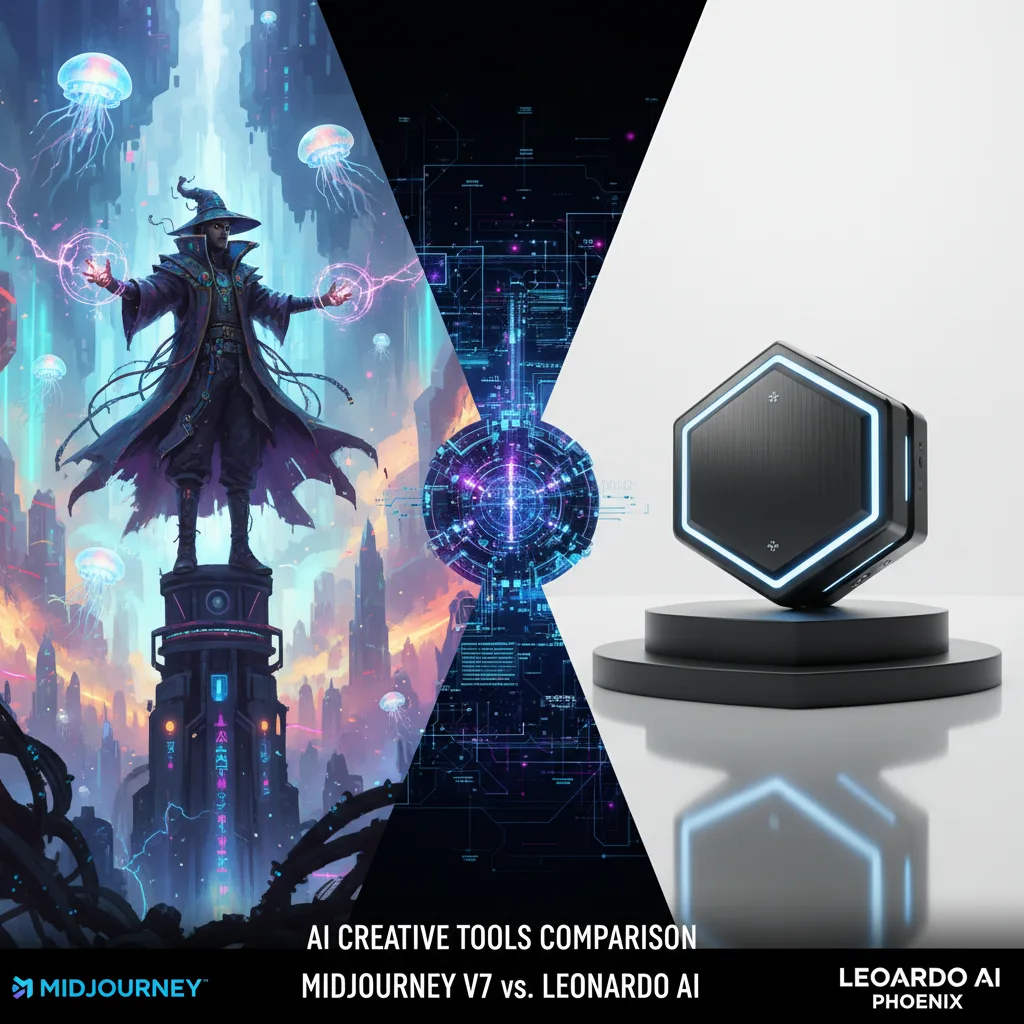


leonardo wins this comparison
The AI image generation landscape has evolved dramatically in 2025, with two platforms commanding the spotlight: Midjourney V7 and Leonardo AI Phoenix. While both deliver stunning visual output, they represent fundamentally different philosophies—Midjourney doubles down on artistic intuition and speed, while Leonardo AI builds a professional toolkit for brand consistency and creative control.
This head-to-head comparison examines how these latest versions stack up across the metrics that matter most to creators, marketers, and professional designers.
Overview: Two Visions for AI Creativity
Midjourney V7, launched April 4, 2025, marks the platform’s first architectural rebuild in nearly a year. With over 21 million users, Midjourney has built its reputation on atmospheric, emotionally resonant imagery that often feels more like digital art than AI generation. The Discord-based workflow remains central, though a web interface is now in alpha.
Leonardo AI Phoenix, built on Leonardo’s proprietary foundational model, has taken a different path, prioritizing accessibility and professional integration. The January 2025 Google Cloud partnership and Canva acquisition signal clear enterprise ambitions. Leonardo processes 4.5 million images daily and has facilitated creation of over 1 billion artworks, positioning itself as the business-friendly alternative with robust editing tools.
Feature Comparison: Speed vs. Control
Generation Speed & Modes
Midjourney V7 introduces Draft Mode, delivering 10x faster rendering at 50% cost reduction—ideal for rapid iteration. Voice input integrates directly with Draft Mode, allowing real-time verbal feedback. For final renders, Turbo Mode runs at 2x standard cost, while Relax Mode offers unlimited slower generation after fast hours deplete.
Leonardo Phoenix lacks equivalent speed modes but compensates with Flow State, generating continuous image streams for real-time creative exploration. Bulk generation produces up to 8 images simultaneously, doubling Midjourney’s standard 4-image grid.
Winner: Midjourney V7 for raw speed; Leonardo for simultaneous output volume.
Customization & Editing
This is where Leonardo Phoenix pulls ahead decisively. Its Elements system lets users mix LoRA models for layered style control, while custom model training enables brand-specific aesthetics and character consistency—critical for marketing campaigns. The Real-Time Canvas provides instant visual feedback as you sketch, and Infinite Mode Editing offers comprehensive manual adjustments.
Midjourney V7 currently lacks native upscaling, inpainting, and retexturing (falling back to V6). The new personalization system requires rating 200 image pairs but offers limited granular control compared to Leonardo’s toolkit.
Winner: Leonardo Phoenix by a significant margin.
Interface & Accessibility
Leonardo’s clean, web-based interface wins for beginners. Automatic prompt enhancement transforms simple descriptions into detailed, effective prompts. The platform feels like a professional design tool.
Midjourney’s Discord roots remain a barrier for newcomers, though the alpha web interface (alpha.midjourney.com) shows promise. Command-based interaction (/imagine, --ar 16:9) creates a steeper learning curve but offers power-user flexibility.
Winner: Leonardo Phoenix for accessibility; Midjourney for power-user control.
Quality Comparison: Artistic Soul vs. Professional Precision
Visual Fidelity & Style
Midjourney V7 excels at artistic expression. The ground-up architectural rebuild delivers enhanced material realism—skin wrinkles, ceramic textures, dynamic lighting—with improved anatomical coherence in hands and faces. The output carries an emotional, atmospheric quality that makes it unbeatable for concept art, fantasy illustration, and visual storytelling. However, text rendering remains problematic, with garbled or misplaced characters common.
Leonardo Phoenix leans toward photorealism and professional aesthetics. The model produces cleaner, more predictable results with superior text rendering capabilities. Product photography, mockups, and brand materials look natural and consistent. While it may lack Midjourney’s “wow factor” for pure artistry, it delivers reliability that businesses demand.
Winner: Midjourney V7 for artistic depth; Leonardo Phoenix for commercial accuracy.
Prompt Adherence & Consistency
Midjourney V7 shows improved prompt interpretation for complex instructions, yet maintains an element of creative surprise—sometimes interpreting prompts in unexpected ways that delight artists but frustrate designers needing precision.
Leonardo Phoenix demonstrates stronger adherence to specific brand guidelines and character descriptions. The ability to train custom models means repeatable results across campaigns, a crucial advantage for commercial work.
Winner: Leonardo Phoenix for professional consistency; Midjourney V7 for creative interpretation.
Pricing: Token Flexibility vs. Unlimited Potential
Midjourney V7 Pricing (2025)
| Plan | Monthly | Annual | Fast GPU Time | V7 Cost Multiplier |
|---|---|---|---|---|
| Basic | $10 | $96 | ~3.3 hours | 2x V6 rates |
| Standard | $30 | $288 | 15 hours | 2x V6 rates |
| Pro | $60 | $576 | 30 hours | 2x V6 rates |
| Mega | $120 | $1,152 | 60+ hours | 2x V6 rates |
Key Advantage: Unlimited Relax Mode after fast hours exhaustion provides a hard cost ceiling.
Leonardo AI Phoenix Pricing (2025)
| Plan | Monthly | Annual | Fast Tokens/Month | Image Capacity |
|---|---|---|---|---|
| Free | $0 | $0 | 150/day | ~45 images/day |
| Apprentice | $12 | $10/mo | 8,500 | ~1,000+ images |
| Artisan | $30 | $24/mo | 25,000 | ~3,000+ images |
| Maestro | $60 | $48/mo | 60,000 | ~7,500+ images |
Token Costs: Basic generation (5-8 tokens), upscaling (5-10 tokens), Motion 2.0 video (200 tokens), Veo 3 video (2,500 tokens).
Value Analysis
For high-volume users, Midjourney’s Standard plan ($30/month) with unlimited Relax Mode offers superior value. Leonardo’s Artisan plan at the same price tier generates fewer images before requiring token replenishment.
For occasional creators and businesses, Leonardo’s free tier and token-based flexibility win. The ability to generate professional-quality images without subscription commitment lowers the barrier to entry. Video generation, while expensive (2,500 tokens for 8-second Veo 3), is at least available—Midjourney’s V1 video model launched in June 2025.
Winner: Leonardo Phoenix for flexibility and entry cost; Midjourney V7 for high-volume production.
Use Cases: Matching Tool to Task
Choose Midjourney V7 If You:
- Create concept art, fantasy art, or atmospheric illustrations
- Value artistic interpretation over pixel-perfect accuracy
- Need rapid iteration for creative brainstorming (Draft Mode)
- Thrive in a large community environment for inspiration
- Prioritize speed in your workflow
- Have technical command-line comfort or are willing to learn
Ideal for: Professional illustrators, game artists, film concept designers, creative directors exploring visual directions.
Choose Leonardo AI Phoenix If You:
- Produce marketing materials, product photos, or brand assets
- Require character consistency across campaigns
- Need reliable text rendering in images
- Prefer a visual, web-based interface with editing tools
- Want custom model training for brand-specific aesthetics
- Are new to AI image generation or work in a team environment
- Need video generation capabilities with flexible quality options
Ideal for: Marketing agencies, e-commerce brands, graphic designers, social media managers, small business owners.
Verdict: Leonardo Phoenix Wins on Overall Value
After evaluating both platforms across six critical dimensions, Leonardo AI Phoenix emerges as the winner for overall value—but with important caveats based on your specific needs.
Why Leonardo Phoenix Wins
- Accessibility: The free tier and intuitive web interface democratize professional-quality AI generation.
- Professional Toolkit: Custom model training, Real-Time Canvas, and comprehensive editing tools make it a complete production solution rather than just a generator.
- Brand Consistency: For commercial work, the ability to maintain character and style across thousands of images is invaluable.
- Text Rendering: Superior handling of typography makes it practical for marketing and design work.
- Integration: The Canva acquisition and Google Cloud partnership signal long-term platform stability and ecosystem integration.
Where Midjourney V7 Still Dominates
For pure artistic expression, Midjourney V7 remains unbeaten. Its atmospheric quality, community-driven development, and Draft Mode speed make it the choice for creators prioritizing emotional impact over commercial precision. If your work lives in concept art, fantasy illustration, or creative exploration, Midjourney V7’s artistic soul justifies its learning curve and cost structure.
The Bottom Line
The platforms have diverged into complementary rather than directly competitive tools. Leonardo Phoenix is the pragmatic choice for professionals needing reliable, brand-consistent output with editing control—essentially an AI-powered design suite. Midjourney V7 is the artist’s muse, optimized for breathtaking visual storytelling at the expense of granular control.
For most users seeking overall value, especially those with commercial applications, Leonardo Phoenix’s free entry point, professional features, and predictable workflow make it the smarter investment. Artists chasing magic, however, will find Midjourney V7’s creative serendipity worth every penny.
For more AI image generation comparisons, check out our complete guide to the best AI image generators in 2025 or explore how these tools stack up against other competitors like Midjourney V7 vs Flux models and Midjourney vs DALL-E 3. If you’re just getting started, our master guide to AI image prompting will help you get the most out of whichever platform you choose.