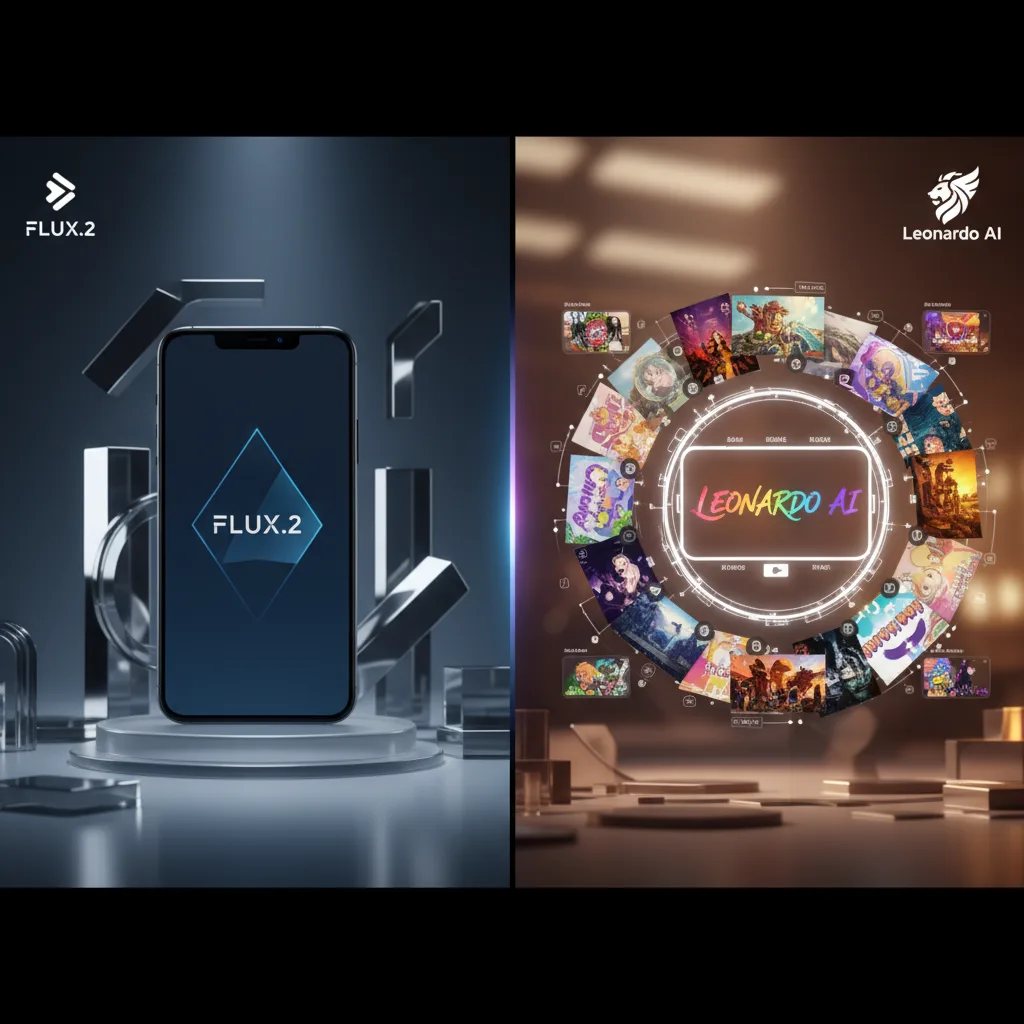


flux wins this comparison
The AI image generation landscape has fractured into two distinct philosophies. On one side, Black Forest Labs’ Flux.2 represents a pure pursuit of technical excellence—32 billion parameters, 4-megapixel outputs, and production-grade precision. On the other, Leonardo AI’s Phoenix model, now backed by Canva’s ecosystem, delivers an accessible, integrated creative suite that prioritizes breadth over depth.
Both platforms launched major updates in late 2025, but they serve fundamentally different masters. This comparison pits these two titans head-to-head across every dimension that matters to creators, from raw quality to real-world pricing and workflow integration.
Overview: Two Visions for AI Creativity
Flux.2: The Technical Powerhouse
Black Forest Labs emerged in 2024 with a clear mission: build the most capable open-core visual AI on the market. Flux.2, released November 25, 2025, delivers on that promise with a staggering 32-billion parameter architecture that combines a Mistral-3 24B vision-language model with a rectified flow transformer.
The system’s crown jewel is its latent flow matching approach, optimized through a new FLUX.2 VAE that balances learnability, quality, and compression. This isn’t just an incremental improvement—it’s a fundamental rethinking of how diffusion models handle visual coherence and prompt adherence.
Flux.2 comes in four distinct variants: [PRO] for managed API access with commercial-grade quality, [FLEX] for developers needing parameter control, [DEV] as a 32B open-weight model under non-commercial license, and [KLEIN] as a forthcoming Apache 2.0 distilled version for resource-constrained environments.
Leonardo AI (Phoenix): The Accessible Ecosystem
Leonardo AI, acquired by Canva in 2024, has evolved from a specialized AI art tool into a comprehensive creative platform. The Phoenix model emphasizes reliability and scalability over raw parameter counts.
Unlike Flux.2’s focused approach, Leonardo AI spreads its capabilities across multiple tools: image generation, video creation through Motion 2.0 and Veo 3, custom model training, and deep integration with Canva’s design suite. The platform’s philosophy centers on democratization—making AI creativity accessible to non-technical users through intuitive interfaces and generous free tiers.
Feature Comparison: Depth vs Breadth
| Feature | Flux.2 | Leonardo AI (Phoenix) |
|---|---|---|
| Maximum Resolution | 4 megapixels (4MP) | 1K-2K typical |
| Text Rendering | Excellent—handles complex typography, UI layouts, infographics | Good—flexible but less reliable for complex layouts |
| Character Consistency | High—maintains stable identity across scenes | Medium-high—good but less robust |
| Multi-Reference Support | Up to 10 images for style/character consistency | Limited |
| Image Editing | Text-driven editing from multiple references | Magic Edits with selective modification |
| Video Generation | Not a primary focus | Motion 2.0 (5s) and Veo 3 (8s) |
| Custom Model Training | Limited support | Up to 50 custom models on Maestro |
| Model Architecture | 32 billion parameters, latent flow matching | Proprietary, Google Cloud scaled |
| Open-Weight Option | Yes (FLUX.2 [dev]) | No |
| Free Tier | None | 150 tokens daily |
| Commercial License | Available for purchase | Included with subscription |
Quality Comparison: The Resolution Revolution
Photorealism and Detail
Flux.2 establishes a new ceiling for AI-generated photorealism. The 4MP native resolution produces images with genuine print-quality detail, capturing subtle texture variations, accurate depth of field, and physically plausible lighting that rivals professional photography. The model’s improved world knowledge manifests in better spatial reasoning—objects occupy believable volumes, shadows fall correctly, and materials reflect light with accuracy.
Leonardo’s Phoenix generates strong photorealistic results but operates at lower typical resolutions. While sufficient for digital displays and social media, it lacks the pixel density required for large-format printing or high-end commercial work. The quality is impressive for most use cases but doesn’t match Flux.2’s production-grade output.
Text Rendering: A Clear Winner
This category isn’t close. Flux.2 renders complex typography with near-perfect legibility, handling multi-line text blocks, varied fonts, and integrated UI elements with remarkable accuracy. It reliably produces infographics, memes, and branded materials where text must be pixel-perfect.
Leonardo handles simple text overlays adequately but struggles with dense typography, longer passages, or complex layouts. For creators producing marketing materials, book covers, or any text-heavy visuals, Flux.2’s superiority is decisive.
Prompt Adherence and Consistency
Flux.2 demonstrates superior prompt adherence, particularly for complex, multi-element compositions. Its ability to maintain character consistency across up to 10 reference images enables serialized storytelling, product line visualization, and brand asset creation that remains coherent across dozens of generations.
Leonardo performs well with straightforward prompts but shows more variation when handling detailed instructions. Its character consistency is solid for medium-complexity projects but doesn’t match Flux.2’s systematic approach to identity preservation.
Pricing: Transparency vs Accessibility
Leonardo AI’s Clear Tier Structure
Leonardo AI wins on pricing transparency and accessibility:
- Free: 150 daily tokens, watermarked videos, public generations
- Apprentice: $12/month ($10 annually) for 8,500 tokens, private generations, 10 custom models
- Artisan: $30/month ($24 annually) for 25,000 tokens, unlimited relaxed generation, 20 custom models
- Maestro: $60/month ($48 annually) for 60,000 tokens, unlimited relaxed image/video, 50 custom models
- Teams: Custom enterprise pricing
Basic image generation costs 5-8 tokens, making the Apprentice plan viable for regular creators. Video generation is expensive—Veo 3 costs 2,500 tokens for 8 seconds—but the option exists.
Flux.2’s Opaque but Flexible Model
Flux.2 uses a megapixel-based consumption model through partner platforms, but specific pricing isn’t publicly standardized. The [DEV] model offers a path for technical users: free non-commercial use with local deployment on quantized 18GB-24GB GPUs, or full-precision deployment for those with 80GB+ VRAM. Commercial licenses are available upon request.
While Flux.2 lacks a free tier, its open-weight approach provides cost-free access for those with sufficient hardware. The [PRO] tier through managed APIs offers predictable pricing for enterprise users, though exact rates require direct consultation.
Use Cases: Matching Tools to Needs
When to Choose Flux.2
- High-resolution commercial photography: Product shots, fashion campaigns, architectural visualization
- Branded content creation: Logo integration, marketing materials with specific typography
- Character-driven narratives: Comic series, storyboards, serialized visual content requiring consistency
- Print production: Magazine covers, posters, packaging design needing 4MP+ resolution
- Technical documentation: Infographics, diagrams, UI mockups with precise text rendering
- Local deployment: Organizations requiring on-premise generation with full model control
When to Choose Leonardo AI
- Social media content: Quick generation of posts, stories, and creative assets
- Video creation: Short-form video content for marketing or creative projects
- Beginner exploration: Learning AI art without financial commitment
- Rapid prototyping: Fast iteration on creative concepts with unlimited relaxed generation
- Custom style development: Training personal models for unique artistic voices
- Integrated design workflows: Direct connection to Canva’s design tools
Verdict: Production Value Wins
Winner: Flux.2
The verdict depends entirely on your definition of “value.” For professional creators and production studios, Flux.2 delivers unmatched quality, resolution, and control that justifies its premium positioning. The ability to generate print-ready 4MP images with flawless text rendering and multi-reference consistency translates directly to commercial value.
Leonardo AI excels at accessibility and ecosystem integration. Its generous free tier and affordable subscriptions make it the obvious choice for hobbyists, social media creators, and small businesses prioritizing breadth over absolute quality. The video generation capabilities and Canva integration create a workflow advantage for certain use cases.
However, when evaluating overall value for serious creators, Flux.2’s technical superiority and open-core flexibility edge out Leonardo’s convenience. The production-grade output quality, recent $300M funding round signaling long-term development, and the [DEV] model’s availability for technical teams create a more compelling proposition for those whose work demands the best possible results.
Choose Flux.2 if your work requires maximum quality, resolution, and control. It’s the tool for professionals who view AI generation as a production pipeline rather than a creative toy.
Choose Leonardo AI if you’re budget-conscious, need video capabilities, or value an integrated creative ecosystem over raw output quality. It’s the platform for democratizing AI creativity.
For most professional applications, Flux.2’s depth beats Leonardo’s breadth. For more AI image generator comparisons, check out our complete guide to the best AI image generators in 2025, or explore how Midjourney V7 compares to other leading platforms. If you’re just getting started, our master guide to AI image prompting will help you get the most out of either platform.