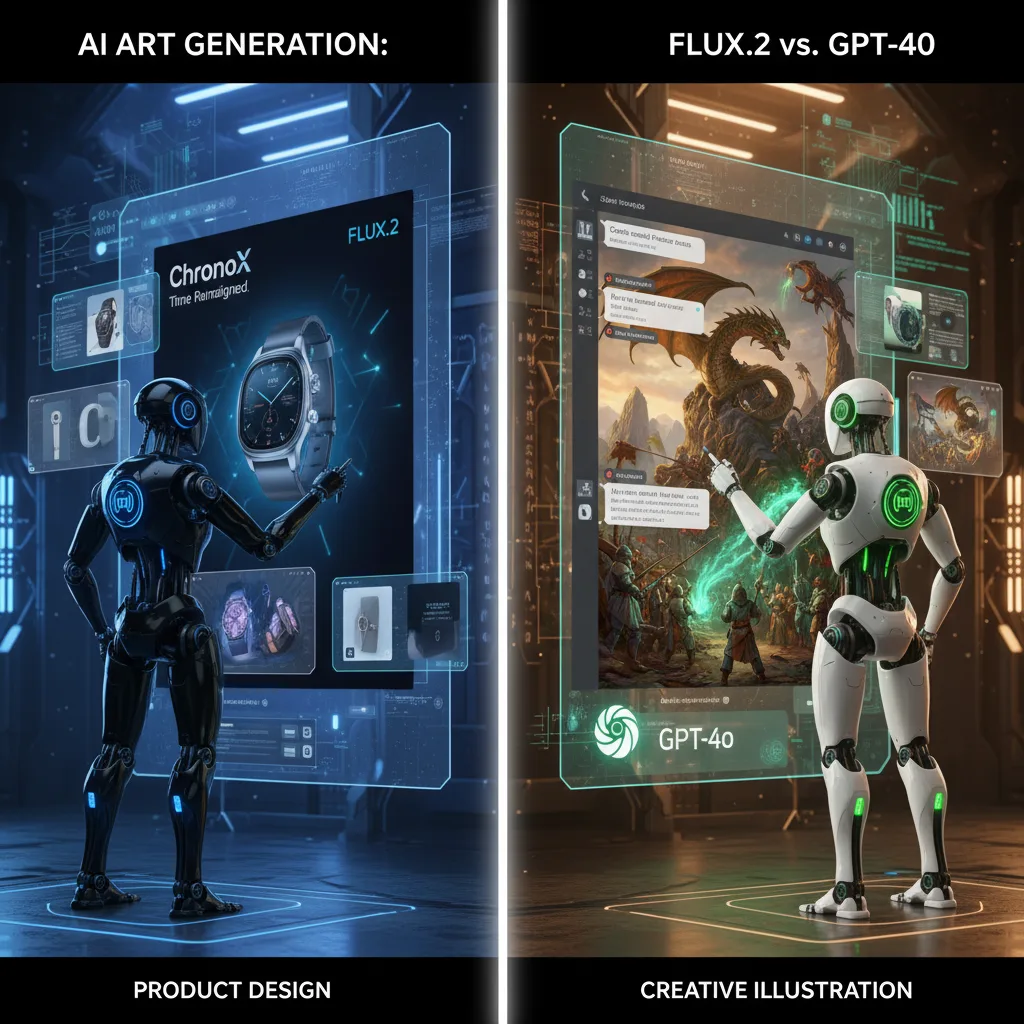


flux wins this comparison
The AI image generation landscape has shifted dramatically in 2025. On one side, Black Forest Labs’ Flux.2 burst onto the scene in late November with groundbreaking multi-reference capabilities and open-weight accessibility. On the other, OpenAI’s GPT-4o Image—the evolution of DALL-E 3—has been refining its integrated approach since March, promising seamless chat-based creation with dramatically improved text accuracy.
Both tools represent the cutting edge, but they serve fundamentally different audiences. This head-to-head comparison examines real-world performance, technical capabilities, and value propositions to help you choose the right platform for your creative workflow.
Overview: Two Philosophies, One Goal
Flux.2 arrives as a direct challenger to closed ecosystems. Released November 25, 2025 (announced November 24), it introduces a latent flow matching architecture with a rectified flow transformer, coupled with a Mistral-3 24B parameter vision-language model. The system offers four distinct variants: [pro] for maximum quality, [flex] for developer control, [dev] as a 32B open-weight model, and [klein] (size-distilled, arriving soon). A strategic NVIDIA partnership announced the following day promises FP8 optimization delivering 40% performance improvements.
GPT-4o Image, launched March 25, 2025, represents OpenAI’s unified vision: embedding powerful generation directly into the ChatGPT experience. While technically an enhancement of DALL-E 3 rather than a full architectural replacement, it pairs GPT-4o’s language understanding with visual synthesis to achieve 95% character accuracy—dramatically up from DALL-E 3’s 68%. The integration prioritizes conversational workflow over granular control.
Feature Comparison: Specs That Matter
| Capability | Flux.2 | GPT-4o Image |
|---|---|---|
| Max Resolution | 4 megapixels (2,000+ pixels on longest side) | 1792x1024 pixels |
| Multi-Reference Input | Up to 10 reference images | Not available |
| Generation Speed | Under 10 seconds | 5-60+ seconds (prompt dependent) |
| Text Rendering Accuracy | Complex typography, precise character control | 95% character accuracy |
| Object Retention | Strong prompt adherence | 20+ objects tracked |
| Open-Weight Availability | Yes (FLUX.2 [dev]) | No |
| API Availability | 8+ platforms (FAL, Replicate, TogetherAI) | OpenAI API only |
| Local Deployment | Yes | No |
The resolution difference immediately stands out: Flux.2’s 4MP output provides significantly more pixels for professional printing and detailed editing. The multi-reference capability—allowing up to 10 input images to guide style, composition, and character consistency—gives Flux.2 a unique edge for brand work and character-driven storytelling.
GPT-4o counters with raw text accuracy and superior object retention in complex scenes. In testing, it correctly rendered all 20 elements in a crowded coffee shop scene where DALL-E 3 omitted 2-3 objects entirely.
Quality Comparison: Where the Pixels Meet the Eye
Photorealism and Lighting
Flux.2 establishes a new benchmark for photorealistic output. Its flow matching architecture excels at physical accuracy—reflections, subsurface scattering, and natural lighting behave predictably. Professional photographers note that Flux.2 images require less post-processing to achieve commercial viability, particularly for product visualization and architectural renders.
GPT-4o produces compelling imagery but occasionally suffers from the “slightly too perfect” syndrome common to earlier DALL-E iterations. While improved, its lighting can feel slightly stylized compared to Flux.2’s grounded physical simulation.
Text Rendering
This category reveals the starkest contrast. Flux.2 handles complex typography with precision—multiple fonts, precise kerning, and multi-line layouts render accurately even at small sizes. The model understands typographic hierarchy and can place text naturally within scenes.
GPT-4o achieves 95% character accuracy, a massive leap over DALL-E 3’s 68% subheading accuracy. Short text blocks and simple signage look excellent. However, it still struggles with longer passages, complex layouts, and fonts requiring fine-grained spacing control. For logo design or editorial mockups, Flux.2 maintains the edge.
Prompt Adherence and Editability
Flux.2’s [flex] variant offers developers unprecedented control over the generation process. The open-weight [dev] model enables fine-tuning for specific domains—fashion brands can train on their product catalog, game studios can build consistent character generators.
GPT-4o shines in conversational refinement. Asking “make the background more moody” or “change her outfit to red” within ChatGPT feels natural and often produces excellent results. However, this flexibility comes at the cost of reproducibility; the same prompt can yield different interpretations across sessions.
Pricing: The Value Equation
Flux.2 embraces accessibility. The [dev] model runs free on Hugging Face and can be deployed locally on consumer hardware with sufficient VRAM. Commercial API pricing remains competitive but undisclosed across the eight partnered platforms—expect market-rate pricing that undercuts OpenAI’s premium model. For high-volume users and startups, the ability to self-host eliminates per-image costs entirely.
GPT-4o Image carries OpenAI’s premium positioning. ChatGPT Plus subscribers ($20/month) receive unlimited generations within rate limits. API access costs $0.04-0.12 per image depending on resolution. Free access through Bing provides limited daily generations with watermarks and lower priority.
The math favors Flux.2 for professional pipelines: a marketing agency generating 1,000 images monthly would spend $40-120 via GPT-4o API versus potentially zero after initial setup with self-hosted Flux.2.
Use Cases: Matching Tool to Task
Choose Flux.2 When You Need:
- Brand Consistency: Multi-reference keeps characters and products consistent across campaigns
- Print-Ready Output: 4MP resolution meets commercial print standards without upscaling
- Complex Typography: Editorial design, packaging mockups, and logo development
- Cost-Effective Scaling: Self-hosting eliminates per-image fees for high-volume workflows
- Development Integration: Build custom tools and workflows with open-weight models
- Product Photography: Superior photorealism reduces need for physical photoshoots
Choose GPT-4o Image When You Need:
- Rapid Ideation: ChatGPT integration enables brainstorming and iteration through conversation
- Complex Scene Composition: Superior object retention for crowded, detailed environments
- Seamless Workflow: Already subscribed to ChatGPT Plus? It’s built into your existing tool
- General Creativity: Hobbyists and solo creators benefit from zero setup friction
- Free Experimentation: Bing access lets you test capabilities without commitment
- Educational Content: Teachers and students can generate visuals directly in learning conversations
Verdict: Flux.2 Wins on Overall Value
For professional creators, developers, and cost-conscious high-volume users, Flux.2 emerges as the clear winner. Its open architecture, superior resolution, multi-reference capabilities, and elimination of per-image costs create a value proposition that’s hard to ignore. The NVIDIA partnership and rapid platform adoption signal strong industry momentum.
GPT-4o Image remains the champion of accessibility. If you’re already in the OpenAI ecosystem or prioritize conversational workflow over granular control, it delivers remarkable quality with zero technical overhead. The 95% character accuracy improvement over DALL-E 3 makes it genuinely viable for many commercial applications.
The choice ultimately reflects your workflow philosophy: Flux.2 empowers you to build a bespoke creative pipeline, while GPT-4o Image offers a polished, ready-to-use experience at a premium price. For those seeking maximum creative control and long-term value, Flux.2 represents the future of democratized AI imaging.
Looking for more AI image generator comparisons? Check out our comprehensive guide to the best AI image generators in 2025, or see how these tools stack up against other leading platforms in our Midjourney V7 vs Flux 2 comparison. For those interested in the latest developments from Black Forest Labs, read about Flux.2’s groundbreaking release.