


The next chapter in open visual intelligence has arrived. Black Forest Labs (BFL), the research collective behind the widely adopted Flux.1 ecosystem, has officially released Flux.2—a generative image model engineered not for viral demos, but for the disciplined demands of modern creative production. With its launch, BFL is doubling down on an open-core philosophy that pairs studio-grade performance with transparent, community-driven innovation.
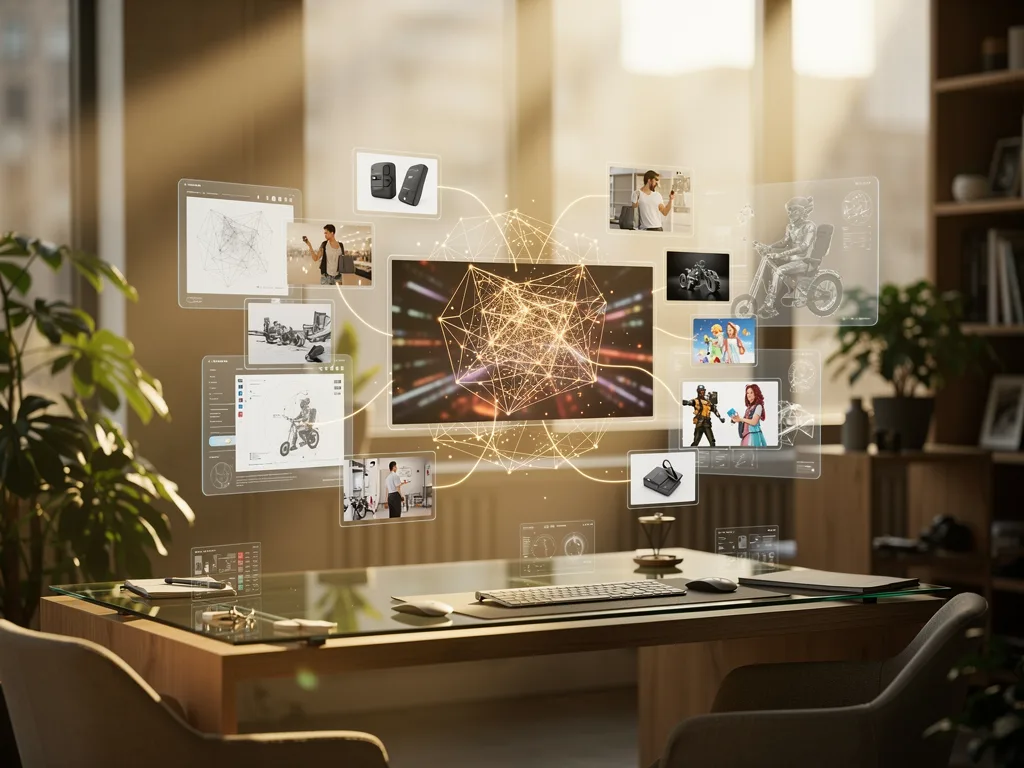
The featured image for this article was generated using Flux.2 Pro, demonstrating the model’s ability to render complex conceptual visuals with precise stylistic control.
What Is Flux.2?
Flux.2 is a foundation model that transforms text prompts, reference images, and structural guidelines into high-fidelity visuals up to 4 megapixels. While its predecessor Flux.1 proved that open models could compete with closed systems, Flux.2 moves the goalpost entirely—targeting the operational workflows of brand teams, performance marketers, product designers, and independent creators who need reliability, not just novelty.
The model architecture represents a clean-slate redesign: a 32-billion-parameter flow matching transformer coupled with Mistral-3 24B parameter vision-language model as its vision-language backbone. This isn’t an incremental update—it’s a ground-up rethinking of how generative models should serve creative professionals.
The Open-Core Philosophy
BFL’s mission remains consistent: visual intelligence should be shaped by researchers, creators, and developers everywhere—not concentrated in a few hands. The Flux.2 release reflects this through a tiered offering that balances accessibility with commercial viability:
- Open weights for experimentation and transparency
- Production APIs for scale, speed, and governance
- Fine-tuning pathways for brand-specific customization
This approach invites scrutiny, lowers barriers to entry, and ensures that the technology evolves through collective iteration rather than isolated R&D.
Key Capabilities That Redefine Production Workflows
Multi-Reference Generation
Flux.2 can ingest up to 10 reference images simultaneously (up to 8 via API for [pro] with 9MP total limit, up to 10 for [flex], and recommended max 6 for [dev]), achieving industry-leading consistency in characters, products, and visual style. For brand teams building campaign assets, this eliminates the “slot machine” effect of earlier models—where generating a series of matching visuals required exhaustive prompt engineering and luck.
Photorealism Without the “AI Tell”
Sharper textures, stable lighting, and physics-aware composition produce images that hold up under commercial scrutiny. Product photography, architectural visualization, and lifestyle content now render with fewer artifacts and more predictable environmental coherence. The model’s expanded world knowledge understands spatial relationships, material properties, and real-world context cues.
Advanced Text Rendering
Typography, infographics, UI mockups, and multilingual content generate with reliably legible fine text—a historic weakness in generative models. This unlocks use cases from packaging design to data visualization without manual post-production.
Surgical Prompt Obedience
Complex, multi-section prompts with compositional constraints are followed with unprecedented accuracy. Creative directors can now use familiar visual language—“cinematic lighting,” “macro lens,” “rule-of-thirds placement”—and expect results that align with intent.
The Flux.2 Family: Four Flavors, One Architecture
BFL has architected four distinct variants, each optimized for different scales and use cases:
Flux.2 [pro]
- State-of-the-art quality rivaling closed systems
- Fastest generation with zero compromise
- Available via BFL Playground, API, and launch partners
Flux.2 [flex]
- Full parameter control (steps, guidance scale)
- Exceptional at text and fine-detail rendering
- Ideal for developers needing granular tuning
Flux.2 [dev]
- 32B open-weight model under non-commercial license (FLUX.2-dev Non Commercial License with mandatory safety filtering), while the VAE is Apache 2.0 licensed for commercial use
- Most capable open checkpoint for image generation and editing
- Runnable on consumer RTX GPUs via FP8 quantization
- Weights on Hugging Face; inference code on GitHub
Flux.2 [klein] (coming soon)
- Apache 2.0 licensed, distilled from base model
- Developer-friendly and production-ready
- Beta access available now
Technical Underpinnings
The model’s latent flow matching architecture integrates a re-engineered variational autoencoder (VAE) that solves the classic “learnability-quality-compression” trilemma. Key innovations include:
- Fully parallel transformer blocks that fuse attention and feedforward operations
- Shared modulation parameters across blocks for more efficient training
- No bias parameters throughout the network, improving generalization
- Resolution-dependent timestep schedules for better high-res performance
NVIDIA collaborated with BFL to launch with FP8 quantization, improving efficiency by 40% and making the model accessible on GeForce RTX GPUs through ComfyUI’s optimized weight streaming.
Real-World Implications
For brand and creative teams, Flux.2 accelerates concept exploration from weeks to hours. Mood boards, style guides, and hero concepts can be generated, refined, and approved in a single day.
For performance marketers, the model enables high-volume creative testing without overwhelming design resources. Localize imagery for micro-segments, A/B test visual hypotheses, and map performance patterns to visual attributes.
For product and UX designers, it drafts UI mockups, illustration systems, and empty states that maintain visual cohesion across product surfaces.
For developers and startups, the open-weight dev model provides a transparent foundation for building specialized tools without API dependencies or vendor lock-in.
Getting Started
Flux.2 is available immediately:
- Playground: bfl.ai/play for interactive exploration
- API: Production endpoints with enterprise-grade SLAs
- Open Weights: Hugging Face for local deployment
- ComfyUI: Optimized workflows for RTX GPU owners
- Cloud Partners: FAL, Replicate, Runware, TogetherAI, Cloudflare, DeepInfra
The Verdict
Flux.2 doesn’t just generate better images—it generates better creative processes. By bridging frontier AI capabilities with open access and production-grade control, Black Forest Labs has created a tool that respects the craft of design while eliminating the drudgery of production.
The question isn’t whether AI will transform creative workflows. It’s whether that transformation will be guided by a community of practitioners or locked behind corporate APIs. Flux.2 makes a compelling case for the former.
For organizations ready to treat generative AI as a disciplined creative partner rather than a novelty generator, the path forward is clear: start with focused pilots, build robust prompt libraries, and embed quality governance from day one. The technology is no longer the limiting factor—your imagination is.