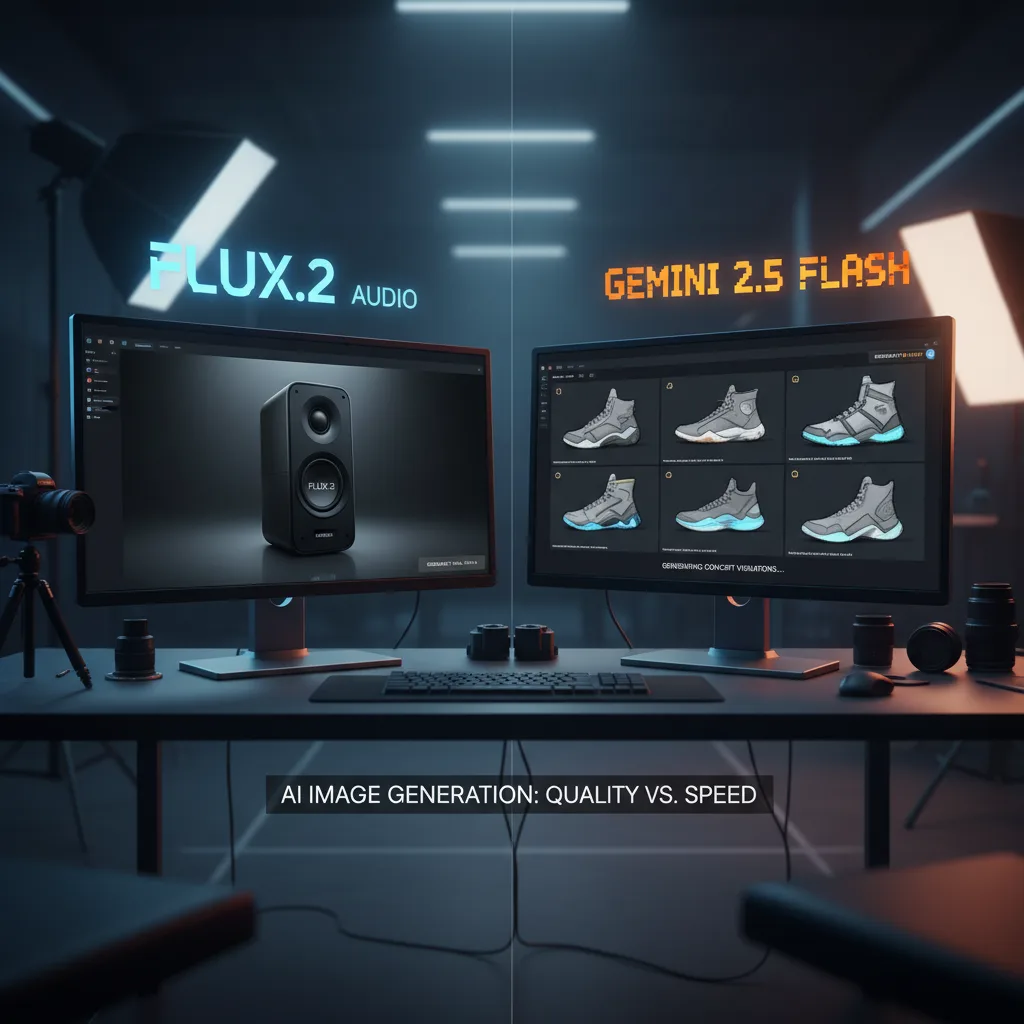



flux wins this comparison
The AI image generation landscape has evolved dramatically with two powerhouse models vying for creative professionals’ attention: Black Forest Labs’ FLUX.2 and Google DeepMind’s Gemini 2.5 Flash Image. Both released in late 2025, these models represent fundamentally different philosophies—one prioritizes maximum quality and control, while the other champions speed and accessibility. Let’s dive into how these frontier-level tools stack up across every dimension that matters to creators.
Overview: Two Paths to Visual Excellence
FLUX.2 arrived on November 25, 2025, as a comprehensive model family built on a novel latent flow matching architecture. It combines a Mistral-3 24B vision-language model with a rectified flow transformer, representing a deliberate shift from traditional diffusion models toward more structured, controllable generation. This technical foundation enables FLUX.2 to achieve “no AI look” photorealism while offering unprecedented control over composition, typography, and consistency.
Gemini 2.5 Flash Image launched earlier, with a preview release on August 26, 2025, reaching general availability on October 2. It leverages Google’s unified multimodal architecture, embedding image generation directly within the Gemini ecosystem. This integration provides native access to Google’s vast world knowledge and semantic understanding, enabling exceptional prompt interpretation and contextual accuracy.
Feature Comparison: Control vs. Convenience
FLUX.2’s Advanced Capabilities
FLUX.2 distinguishes itself through granular control mechanisms that appeal to professional creatives:
- Multi-Reference Mastery: Supports up to 10 reference images simultaneously for character, product, and style consistency without fine-tuning
- Structured Control: JSON prompting, direct pose control, and HEX color code precision for pixel-perfect accuracy
- Resolution Flexibility: Up to 4 megapixels (4K-class) for both generation and editing
- Typography Excellence: Advanced text rendering for infographics, UI mockups, and complex layouts with legible fine text
- Open-Weight Options: FLUX.2 Dev offers a 32B open-weight model (Apache 2.0 license) with LoRA fine-tuning support, runnable on consumer GPUs with NVIDIA optimization
Gemini 2.5 Flash’s Streamlined Approach
Gemini 2.5 Flash prioritizes accessibility and speed through tight ecosystem integration:
- Multi-Image Fusion: Blend multiple images into cohesive outputs
- Conversational Editing: Natural language-based image editing with targeted transformations
- Local Edit Precision: Blur backgrounds, remove objects, alter poses, and colorize black-and-white photos
- Semantic Understanding: Deep world knowledge for culturally accurate and factually informed imagery
- Ecosystem Integration: Native access through Gemini API, Google AI Studio, and Vertex AI for enterprise
Quality Comparison: The Gold Standard vs. The Speed Demon
Visual Fidelity and Realism
FLUX.2 achieves strong performance on the Artificial Analysis visual quality benchmark with Elo ratings ranging from approximately 1029-1048 depending on the variant. Its flow matching architecture produces exceptional photorealism with superior handling of lighting, spatial logic, and material properties. The “no AI look” quality makes it ideal for professional photography substitution and high-end marketing materials.
Gemini 2.5 Flash excels in semantic understanding and contextual accuracy, with the Nano Banana 2 variant ranking among the top performers at approximately 1063 Elo. While it may not match FLUX.2’s absolute visual fidelity, it produces consistently good results with impressive prompt adherence.
Text Rendering and Typography
FLUX.2 demonstrates superior text rendering capabilities, particularly in its Flex variant. It handles complex typography, UI mockups, and infographics with remarkable accuracy—critical for design professionals who need legible, precisely placed text.
Gemini 2.5 Flash offers high-fidelity text rendering for logos, diagrams, and posters, but lacks the granular typographic control that makes FLUX.2 shine in professional design workflows.
Prompt Adherence and Control
FLUX.2 provides exceptional prompt adherence with its structured control mechanisms. The ability to use JSON prompts, pose controls, and precise color specifications gives creators unprecedented command over output.
Gemini 2.5 Flash leverages its world knowledge to interpret abstract concepts and metaphorical descriptions, sometimes understanding intent better than literal prompts. However, it offers less fine-grained control over specific visual elements.
Speed and Performance: A Clear Divide
The speed differential between these models is substantial:
- FLUX.2: 10-15 seconds per generation, prioritizing quality over speed
- Gemini 2.5 Flash: 3-4 seconds standard generation
This threefold speed advantage makes Gemini 2.5 Flash the clear choice for rapid iteration, interactive applications, and high-volume workflows. FLUX.2’s slower pace reflects its computational intensity and commitment to quality.
Pricing: Premium Quality vs. Budget Efficiency
FLUX.2 Pricing Structure
- FLUX.2 Pro: $0.03 for the first megapixel, then $0.015 for each additional megapixel
- Reference Images: $0.015 per megapixel per reference image
- Example Cost: 1024x1024 generation = $0.03
- Flex Variant: Variable pricing based on customizable parameters
- Dev Variant: Open-source, free to run locally
Gemini 2.5 Flash Pricing
- Standard Rate: $30 per million output tokens
- Per Image: Approximately $0.039 per 1024x1024px image (1,290 tokens)
- Free Tier: 500 daily requests via Google AI Studio
- Value Proposition: Undercuts OpenAI’s DALL-E 3 by 40%
For production use, FLUX.2 carries a premium price tag that reflects its superior quality, while Gemini 2.5 Flash offers exceptional value for cost-conscious workflows.
Use Cases: Matching Tool to Task
When to Choose FLUX.2
FLUX.2 excels in scenarios demanding maximum visual quality and control:
- Professional Photography Substitution: Advertising campaigns requiring photorealistic product shots
- Architectural Visualization: High-end renders with precise lighting and materials
- Brand-Compliant Content: Maintaining strict visual identity across campaigns
- Complex Typography: Infographics, UI mockups, and editorial layouts
- Character Consistency: Content series requiring consistent character appearance across multiple generations
- Local Deployment: Organizations requiring on-premise processing or custom fine-tuning
When to Choose Gemini 2.5 Flash
Gemini 2.5 Flash shines in speed-critical and cost-sensitive applications:
- Rapid Prototyping: Quick concept exploration and iteration
- Interactive Applications: Real-time generation for user-facing products
- Educational Content: Technical diagrams and culturally accurate illustrations
- High-Volume Workflows: Batch processing where speed and cost matter most
- Conversational Editing: Natural language-driven image modifications
- Game Development: 3D asset generation with platform integration
Verdict: Quality Wins for Professionals, Speed Wins for Scale
The Winner: FLUX.2 for overall value in professional creative workflows.
FLUX.2’s superior visual quality, advanced control features, and open-weight options make it the better investment for creative professionals where output quality directly impacts client satisfaction and brand perception. The ability to generate truly photorealistic images without the telltale “AI look” justifies its premium pricing and slower generation times for production-grade work.
However, this victory comes with important caveats. Gemini 2.5 Flash decisively wins on speed and cost-efficiency, making it the ideal choice for:
- Early-stage concepting and rapid iteration
- High-volume content production
- Interactive applications requiring real-time generation
- Budget-conscious projects where “good enough” quality is sufficient
The Smart Strategy: Many creative professionals will benefit from using both tools strategically. Employ Gemini 2.5 Flash for initial concepting and rapid exploration, then switch to FLUX.2 for final production assets requiring maximum quality. This hybrid approach optimizes both workflow efficiency and output excellence.
For enterprise creative teams, the choice often depends on whether the workflow prioritizes creative control and quality (FLUX.2) or speed and cost efficiency (Gemini 2.5 Flash). Neither tool universally outperforms the other—they serve complementary purposes in the modern creative stack.
For more insights on how these tools compare to other leading AI image generators, check out our comprehensive guide to the best AI image generators in 2025. If you’re interested in how FLUX.2 stacks up against other top contenders, our Midjourney V7 vs Flux 2 comparison provides additional perspective. For those looking to maximize their AI image generation skills, our complete prompting guide offers expert techniques for getting the best results from any platform.