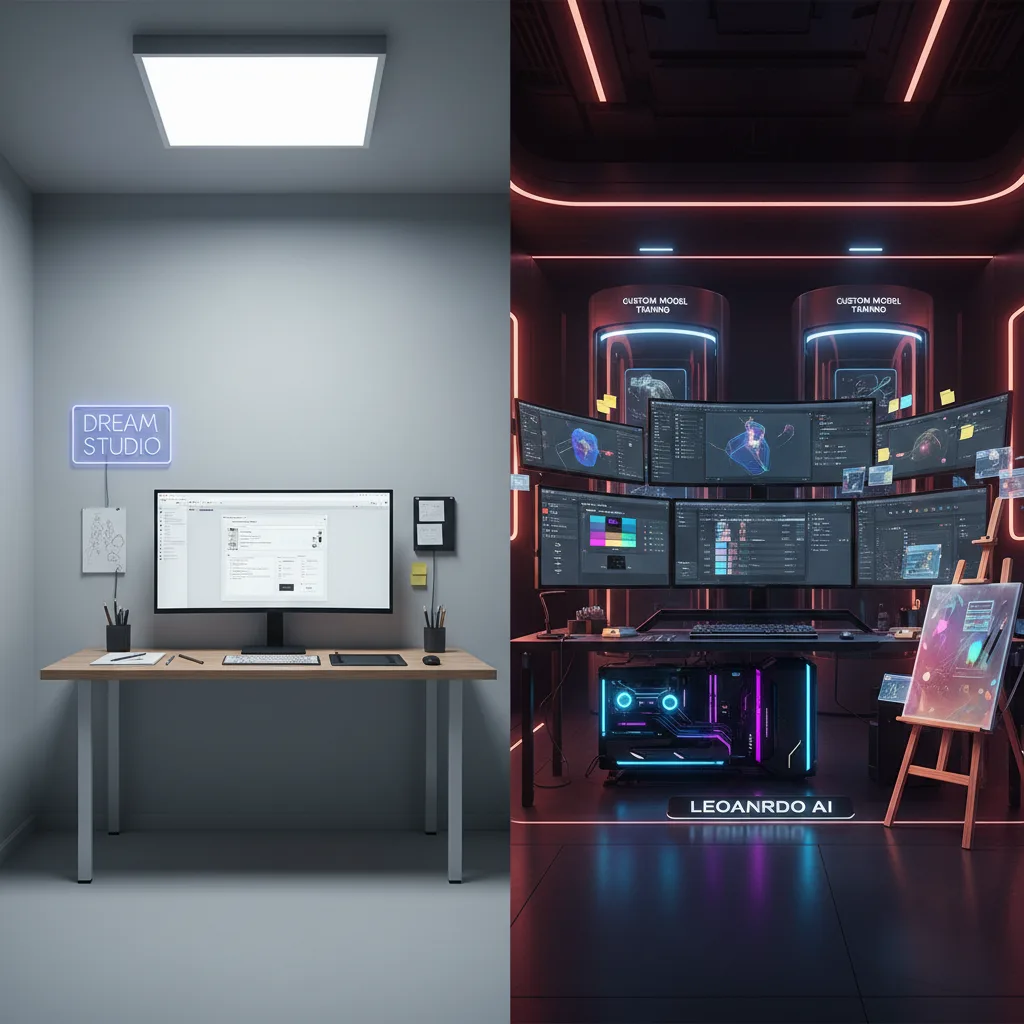


Leonardo AI wins this comparison
The Stable Diffusion ecosystem has matured into two distinct paths for creators: the streamlined, budget-friendly approach of DreamStudio and the feature-rich, premium experience of Leonardo AI. While both platforms harness the same powerful open-source models, they serve fundamentally different creative workflows. DreamStudio offers direct access to Stability AI’s latest models with a simple pay-per-use model, while Leonardo AI wraps Stable Diffusion in a comprehensive creative suite designed for professional production. This comparison reveals which path deserves your time and investment.
The Philosophical Divide: Raw Access vs. Curated Power
DreamStudio represents the minimalist approach—Stability AI’s official web interface that strips away complexity to deliver pure model access. You get the latest Stable Diffusion models (including SDXL and XL Turbo) without technical setup, paying only for what you generate. The platform prioritizes simplicity: sign up, enter a prompt, adjust basic parameters, and create. This barebones philosophy extends to its editing tools, which cover essential inpainting and outpainting but little beyond.
Leonardo AI takes the opposite stance, building an entire creative operating system around Stable Diffusion. The platform offers specialized models like Phoenix for photorealism, RPG-focused generators, and anime-specific tools. Its standout AI Canvas transforms generation from a one-shot process into an iterative workflow where you can edit, refine, and compose images in real-time. Leonardo doesn’t just provide model access—it reimagines how professional creators integrate AI into their existing pipelines.
Pricing Models: Pay-Per-Use vs. Subscription Value
DreamStudio’s Credit Economy New users receive 200 free credits upon signup, with subsequent credits costing approximately $1.18 per 100-credit pack. A typical 512x512 image at 15 steps consumes just 0.1 credits, making light usage extremely affordable. The platform’s pay-per-use model eliminates monthly commitments, appealing to hobbyists and occasional creators. However, heavy users face unpredictable costs—generating 100 high-resolution images daily could exceed $30 monthly.
Leonardo AI’s Token Structure Leonardo provides a generous free tier of 150 tokens daily, translating to 30-75 images depending on settings. Paid subscriptions range from $10 to $60 monthly, offering larger token allocations, faster generation queues, and premium features like private creations. The $24 “Artisan” tier includes 8,500 monthly tokens and three personal model training slots, positioning it as a compelling value for professionals who need consistent output.
For budget-conscious creators, DreamStudio’s lack of subscription fees wins on pure cost. Yet Leonardo’s predictable pricing and included features often prove cheaper for regular users when factoring in the external tools DreamStudio requires for comparable functionality.
Feature Comparison: Where the Premium Justifies Itself
User Interface and Accessibility
DreamStudio delivers a clean, no-frills interface that beginners master within minutes. The prompt box, style selectors, and parameter sliders provide immediate control without overwhelming options. This simplicity becomes limiting for advanced users who crave deeper customization.
Leonardo AI’s interface mirrors professional creative software, with organized panels for collections, datasets, and model management. The learning curve proves steeper, but rewards investment with features like seed locking for consistency, batch generation tools, and integrated asset organization. Creators managing multiple campaigns appreciate the collections system that keeps client work separated and version-controlled.
Model Variety and Specialization
DreamStudio grants direct access to official Stable Diffusion models as Stability AI releases them. You get cutting-edge performance but must handle model selection and prompt engineering yourself. The platform supports custom models through uploaded LoRAs, though this requires technical knowledge.
Leonardo AI curates dozens of specialized models optimized for specific use cases. Game developers access texture generators that create seamless, tileable materials. Concept artists leverage RPG models trained on fantasy art tropes. Photographers use dedicated realism models that require less negative prompting. This curation eliminates experimentation time, delivering reliable results for professional deadlines.
Editing and Refinement Tools
DreamStudio covers basics: inpainting to modify regions, outpainting to extend canvases, and simple upscaling. These tools function adequately but force users into a generate-edit-regenerate loop that slows creative flow.
Leonardo’s AI Canvas revolutionizes this process with real-time generation and layered editing. You can paint a mask, adjust composition, fix anatomical errors, and refine textures without leaving the platform. The background remover, upscaler, and pose control integrate seamlessly, creating a unified workflow that replaces multiple external applications. For commercial artists, this consolidation saves hours weekly.
Custom Model Training
DreamStudio offers no native model training. Users seeking custom styles must train models locally using tools like Dreambooth, then upload LoRAs—a process requiring significant technical skill and hardware.
Leonardo democratizes training with an integrated platform that handles dataset management and training parameters automatically. Users upload 10-20 curated images and receive a custom model within hours. Indie game studios train character-specific models to maintain visual consistency across hundreds of assets. Marketing teams create brand-specific generators that produce on-style content instantly. This feature alone justifies Leonardo’s premium pricing for many professionals.
Performance and Workflow Integration
Generation Speed DreamStudio leverages Stability AI’s cloud infrastructure, delivering consistent 10-30 second generation times regardless of user hardware. Performance remains stable during peak hours, though free tier users may experience queues.
Leonardo’s speed varies by subscription tier. Free users wait 20-40 seconds per image, while paid subscribers receive priority processing that cuts times to under 15 seconds. The token bank system prevents throttling during heavy production weeks, ensuring reliable performance for deadline-driven work.
Professional Workflow Features Leonardo AI targets production environments with features DreamStudio lacks:
- Collections organize assets by project, client, or campaign
- Dataset management streamlines training data preparation
- Style presets ensure consistent output across team members
- API access integrates with existing pipelines and automation
DreamStudio offers API access but minimal workflow management, making it better suited for individual creators than collaborative teams.
Privacy, Security, and Data Control
Both platforms process images on cloud infrastructure, meaning sensitive content passes through third-party servers. DreamStudio’s privacy policy aligns with Stability AI’s corporate standards, but users cannot opt for local processing.
Leonardo AI provides private creation modes on premium tiers, ensuring generated content doesn’t appear in public galleries. However, the platform still processes data externally. For industries with strict compliance requirements, neither solution matches locally-run Stable Diffusion, though Leonardo’s business plans offer enhanced security agreements.
The Verdict: Matching Platform to Creative Needs
Choose DreamStudio If:
- You generate images occasionally and want zero monthly commitment
- You prefer direct access to official Stable Diffusion models without intermediaries
- Your workflow requires simple generation with minimal editing
- You’re a hobbyist or beginner seeking the lowest possible barrier to entry
- You have technical skills to handle custom model training and editing externally
Choose Leonardo AI If:
- You create content daily and need predictable monthly costs
- Your work demands specialized models for specific styles or industries
- You require integrated editing tools to refine images without switching applications
- Custom model training is essential for brand consistency or character development
- You manage multiple projects and need organizational features
- Team collaboration and asset sharing are part of your workflow
The Winner: Leonardo AI for Professionals
For most creative professionals, Leonardo AI’s premium features deliver compelling value that outweighs its subscription cost. The integrated canvas, specialized models, and training capabilities transform Stable Diffusion from a novelty into a production-ready tool. The platform reduces software switching, saves time on revisions, and enables styles impossible with generic models.
DreamStudio remains the ideal entry point and budget champion. Its pay-per-use model and simplicity make it perfect for explorers, educators, and creators who generate fewer than 50 images monthly. For those users, Leonardo’s subscription would be overkill.
Final Takeaway: A Complementary Ecosystem
The choice between DreamStudio and Leonardo AI reflects your position on the creative maturity curve. DreamStudio serves as the gateway drug—affordable, accessible, and powerful enough to spark obsession. Leonardo AI is the professional studio you graduate to when reliability, efficiency, and control become non-negotiable.
Many savvy creators use both: DreamStudio for quick experiments and testing new prompts, Leonardo AI for client work requiring consistency and refinement. This hybrid approach maximizes budget efficiency while maintaining production quality. As Stable Diffusion evolves, expect the gap between budget and premium to widen further, with Leonardo AI adding more professional features while DreamStudio maintains its commitment to simplicity and direct model access.
The real winner is the Stable Diffusion ecosystem itself, which now serves everyone from curious beginners to AAA game studios through these distinct but complementary platforms. For those exploring alternatives, consider checking out our comprehensive guide to the best AI image generators in 2025 or learn how to master AI image prompting to maximize your results on either platform.