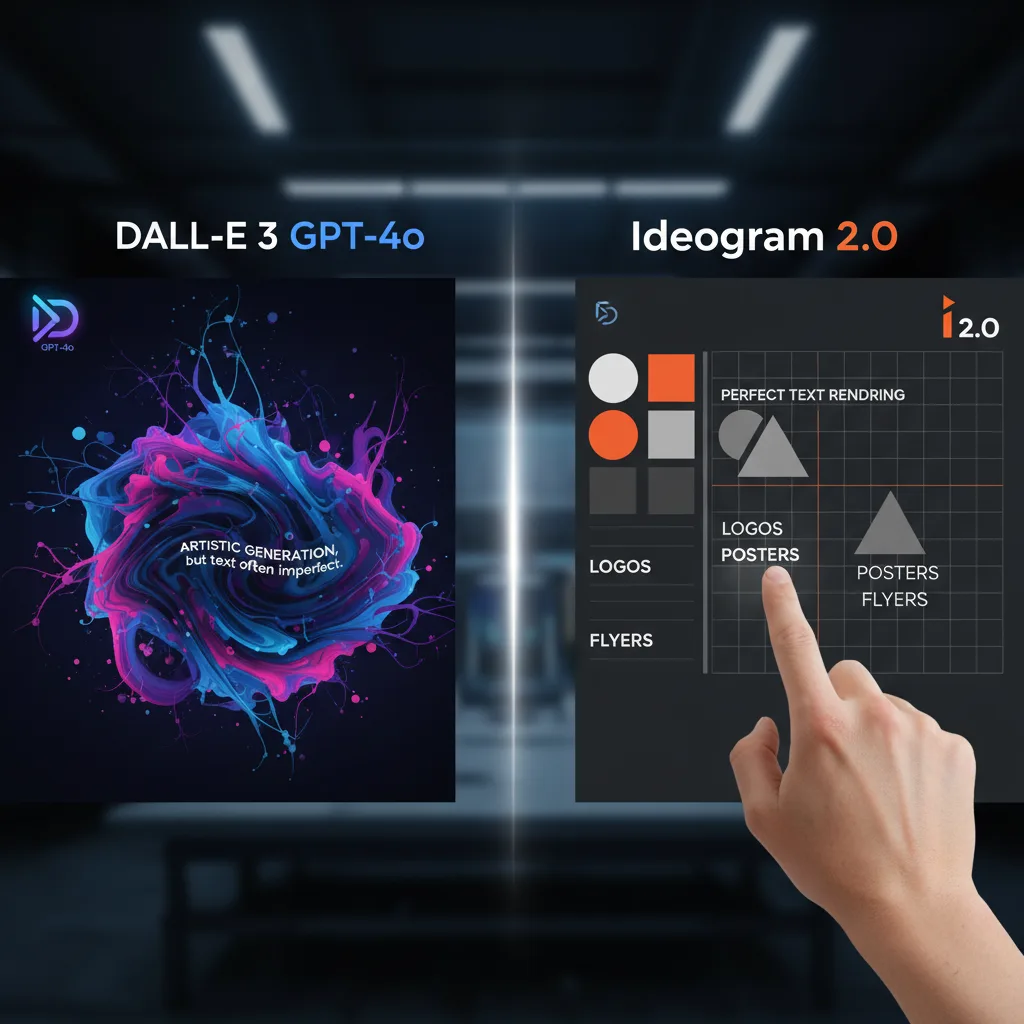



ideogram wins this comparison
The AI image generation landscape has evolved dramatically since late 2024, with two major players vying for creative supremacy: OpenAI’s DALL-E 3 integrated within GPT-4o and Ideogram’s specialized 2.0 platform. While both promise to transform text into compelling visuals, they take fundamentally different approaches. DALL-E 3 leverages the conversational power of GPT-4o for intuitive image creation, whereas Ideogram 2.0 has carved out a niche as the typography champion with design-first features.
This comprehensive comparison examines how these platforms stack up across critical dimensions including output quality, generation speed, pricing value, and specialized capabilities. Whether you’re a graphic designer needing flawless text integration or a creative professional seeking artistic interpretation, understanding these distinctions will determine which tool deserves your subscription dollars.
Overview: Two Philosophies of AI Image Generation
DALL-E 3 (GPT-4o Image) represents OpenAI’s vision of seamless, conversational AI creativity. Announced September 20, 2023 and released to ChatGPT Plus/Enterprise on October 19, 2023, with native image generation added to GPT-4o in March 2025, it prioritizes natural language understanding and accessibility. The system excels at interpreting complex, paragraph-length prompts through ChatGPT’s interface, making it approachable for users who want to refine ideas through dialogue rather than precise engineering. However, this accessibility comes with trade-offs in specialized design capabilities.
Ideogram 2.0, which debuted in August 2024, takes a laser-focused approach to solving one of AI’s biggest historical challenges: legible text within images. Built from the ground up for graphic designers, marketers, and content creators, Ideogram has rapidly evolved into a comprehensive design suite. The platform distinguishes itself with purpose-built features like color palette control, canvas-based editing, and mobile accessibility through its iOS app. By March 2025, Ideogram 3.0 further cemented its position with enhanced realism and lighting improvements.
Feature Comparison: Capabilities That Matter
Text Rendering & Typography
The most striking difference between these platforms emerges in text handling. DALL-E 3 (GPT-4o Image) continues to struggle with typography, frequently producing misspelled words, garbled characters, or distorted letterforms. Users consistently report needing to export images to Photoshop or Canva for manual text correction, undermining workflow efficiency for design projects. The system simply wasn’t architected with typography as a core competency.
Ideogram 2.0, conversely, has established industry-leading text accuracy. Human evaluations consistently rate it superior to not just DALL-E 3 but also competitors like Flux Pro. The platform renders crisp, correctly spelled text across diverse contexts—from movie posters to product packaging—making it the definitive choice for any project where words must be legible and professionally presented. This capability extends to complex layouts, multi-line text blocks, and varied font styles.
Image Quality & Photorealism
Quality metrics tell a nuanced story. DALL-E 3 achieved 62% photographic convincingness in blind tests, while the newer GPT-4o integration reportedly reaches 87% in controlled evaluations, according to third-party benchmarking studies. The system produces images with strong artistic interpretation, good lighting comprehension, and a distinctive “painterly” quality. However, widespread user feedback from community forums and social media earlier in 2025 reveals growing dissatisfaction with output quality, describing results as “dull,” “low resolution,” and “lifeless” compared to earlier versions. Stricter content policies have also reduced creative variety.
Ideogram 2.0 delivers realistic rendering with enhanced textures and improved anatomical accuracy, particularly for human hands and faces. The March 2025 update to version 3.0 introduced natural lighting effects and smoother gradients, narrowing the gap with specialized artistic models. While it may lack some of DALL-E 3’s interpretive flair, Ideogram produces more technically accurate and consistent results, especially for commercial applications requiring precision.
Generation Speed & Performance
Speed favors DALL-E 3, which generates images in 20-45 seconds through the ChatGPT interface. The API delivers similarly quick results, making it suitable for rapid iteration. Ideogram 2.0 operates at speeds competitive with Midjourney—faster than GPT-4o in some benchmarks—though free tier users experience queue delays of several minutes. Priority credits on paid plans eliminate these waits, delivering comparable performance to DALL-E 3 for subscribers.
Prompt Understanding & Refinement
DALL-E 3’s integration with GPT-4o provides unmatched conversational refinement capabilities. Users can engage in natural dialogue to adjust compositions, modify styles, or iterate on concepts without rewriting complex prompts. The system excels at parsing detailed, multi-part instructions and understanding nuanced artistic references.
Ideogram 2.0 offers strong prompt adherence with its improved Magic Prompt feature, which helps users optimize their inputs for better results. The Describe feature allows creative iterations by analyzing existing images, though it lacks the back-and-forth conversational flow that makes DALL-E 3 so intuitive for beginners.
Quality Comparison: Real-World Output Analysis
Photographic Convincingness
In head-to-head blind tests, GPT-4o Image generation demonstrates higher photographic convincingness (87%) than the standalone DALL-E 3 (62%). However, real-world usage reveals inconsistency. Recent updates have introduced aspect ratio issues where 16:9 or 9:16 formats aren’t properly respected, and outputs sometimes appear over-processed or blurry.
Ideogram 2.0 maintains more consistent quality across generation modes. Its realistic style produces lifelike textures and accurate proportions, while the design mode optimizes for commercial aesthetics. The platform’s strength lies in predictable, professional-grade results rather than artistic interpretation.
Anatomical Accuracy
Both platforms have improved significantly in rendering human anatomy, but Ideogram 2.0 holds a slight edge. Hands and faces appear more natural with fewer obvious artifacts. DALL-E 3 still occasionally produces extra fingers or distorted facial features, particularly in complex scenes with multiple subjects.
Artistic Interpretation vs. Design Precision
DALL-E 3 shines when asked to interpret abstract concepts or blend disparate artistic styles. Its GPT-4o foundation enables creative leaps that feel imaginative and inspired. Ideogram 2.0, while capable of artistic styles, prioritizes design precision over creative flair. For marketing materials, brand assets, or any project requiring consistency, Ideogram’s approach proves more valuable.
Pricing: Value Analysis for Different User Types
DALL-E 3 Pricing Structure
- Free Tier: Limited access through ChatGPT Free with usage caps
- ChatGPT Plus: $20/month includes full GPT-4o access plus DALL-E 3 generation
- ChatGPT Pro: $200/month for unlimited access across all models
- API Pricing: $0.04 per 1024×1024 standard image; $0.08 for 1024×1792; HD quality ranges from $0.08 to $0.12 per image
Ideogram 2.0 Pricing Structure
- Free: 10 slow credits weekly (approximately 40 images) with queue delays
- Basic: $8/month ($7/month annually) includes 400 priority credits (~3,200 images)
- Plus: $20/month ($15/month annually) includes 1,000 priority credits (~8,000 images)
- Pro: $60/month ($42/month annually) includes 3,500 priority credits (~28,000 images)
- Team: $30/member/month ($20/member annually) with 1,500 credits per member
Value Assessment
For occasional users generating fewer than 50 images monthly, DALL-E 3’s inclusion in the $20 ChatGPT Plus subscription offers better value, especially if you already use ChatGPT. The pay-per-image API model also suits sporadic needs without monthly commitments.
For frequent creators, Ideogram’s Basic plan at $8/month provides substantially more generation capacity. A graphic designer producing hundreds of marketing assets monthly would find Ideogram’s subscription model 3-4x more economical than DALL-E 3’s per-image pricing. Unused credits expire monthly, requiring active use to maximize value.
Use Cases: Matching Tools to Tasks
When to Choose DALL-E 3 (GPT-4o Image)
- Conceptual Brainstorming: The conversational interface excels at exploring ideas through dialogue
- Artistic Illustration: Superior interpretation of creative styles and abstract concepts
- Occasional Generation: Pay-per-image model avoids subscription fees for infrequent use
- Existing ChatGPT Users: No additional cost if you already subscribe to Plus or Pro
- Rapid Iteration: Faster base generation speed supports quick experimentation
- Complex Prompts: Better handling of multi-paragraph descriptions with nuanced instructions
When to Choose Ideogram 2.0
- Graphic Design Projects: Posters, flyers, social media graphics requiring legible text
- Marketing Materials: Product mockups, advertisements, brand assets with typography
- High-Volume Creation: Subscription model becomes economical above ~100 images monthly
- Mobile Workflow: iOS app enables creation on-the-go; Android version in development
- Brand Consistency: Color palette control ensures cohesive visual identity
- Design Collaboration: Canvas feature supports multi-image layouts and team workflows
- API Integration: Beta API allows embedding into custom design tools
Verdict: The Best Choice for Overall Value
Winner: Ideogram 2.0
For most creative professionals and teams, Ideogram 2.0 delivers superior overall value. Its unbeatable text rendering accuracy eliminates hours of post-processing work, while design-focused features like color palette control and Canvas editing streamline professional workflows. The subscription pricing model rewards frequent use, and the platform’s consistent quality output makes it reliable for client-facing work.
The March 2025 update to Ideogram 3.0 addresses earlier weaknesses in realism and lighting, closing the quality gap while maintaining its core strengths. The iOS app and upcoming Android support provide flexibility that DALL-E 3’s web-only interface cannot match.
DALL-E 3 (GPT-4o Image) remains the better choice for three specific scenarios: first, users who prioritize conversational refinement and natural language interaction over design precision; second, existing ChatGPT subscribers who generate images occasionally; and third, projects requiring maximum artistic interpretation rather than commercial accuracy.
The quality decline complaints plaguing DALL-E 3 since earlier in 2025 cannot be ignored. While OpenAI’s model shows higher peak convincingness in controlled tests, real-world consistency has suffered. Ideogram’s steady improvement trajectory and design-first philosophy make it the more dependable investment for 2025.
Final Recommendation: Choose Ideogram 2.0 for professional design work, marketing content, and high-volume creation. Choose DALL-E 3 (GPT-4o Image) for artistic exploration, conceptual development, and occasional use within the ChatGPT ecosystem. For teams requiring both capabilities, the combination justifies dual subscriptions—use Ideogram for final assets and DALL-E 3 for creative brainstorming.
For a broader perspective on how these tools compare to other leading platforms, check out our comprehensive guide to the best AI image generators in 2025. If you’re specifically interested in how these platforms stack up against other major competitors, our comparison of Midjourney V7 vs Ideogram 3.0 provides additional insights into the current market landscape. For those working with limited budgets, our roundup of the best free AI image generators offers valuable alternatives to explore.