



Pros
- ✓ Excellent character consistency across multiple generations
- ✓ Natural language editing with precise local transformations
- ✓ Multi-image fusion capabilities
- ✓ Competitive pricing at $0.039 per image
Cons
- ✗ Images can look over-processed with heavy bokeh
- ✗ Editing often creates new images rather than true pixel-level changes
- ✗ Struggles with object counting and accurate text rendering
- ✗ Limited to 1024x1024px output resolution
Gemini 2.5 Flash Image delivers impressive consistency and editing features at an attractive price, but falls short of top competitors in photorealism and precise control.
Gemini 2.5 Flash Image Review: Is It Worth It in 2025?
Google’s entry into native AI image generation has matured significantly since its early Imagen days. With the preview launch on August 26, 2025 (General Availability October 2, 2025) of Gemini 2.5 Flash Image—internally dubbed “nano-banana”—the search giant promises a compelling blend of speed, cost-effectiveness, and creative control. But in a crowded field where ChatGPT’s GPT-4o and Meta AI dominate headlines, does Google’s offering deserve a place in your creative toolkit? After extensive testing and analysis of real-world performance, the answer is nuanced: it’s a powerful tool for specific workflows, but not the universal solution Google might hope for.
What Is Gemini 2.5 Flash Image?
Gemini Image Generation represents Google’s first native image generation model built directly into the Gemini ecosystem. Unlike previous iterations that felt tacked onto the chat interface, this model generates and processes images conversationally, allowing for iterative refinement through natural dialogue. Available through the Gemini API, Google AI Studio, and Vertex AI for enterprise users, it is best understood as a token-priced image API rather than a clean flat-fee per-image product.
The model supports multiple input modalities: text prompts, single image references, and multi-image fusion. Every generation carries an invisible SynthID watermark for AI detection, aligning with Google’s responsible AI principles. For developers, integration is straightforward with SDKs in Python, JavaScript, Go, and Java, plus a REST endpoint for custom implementations.
Key Features That Matter
Character Consistency Across Generations
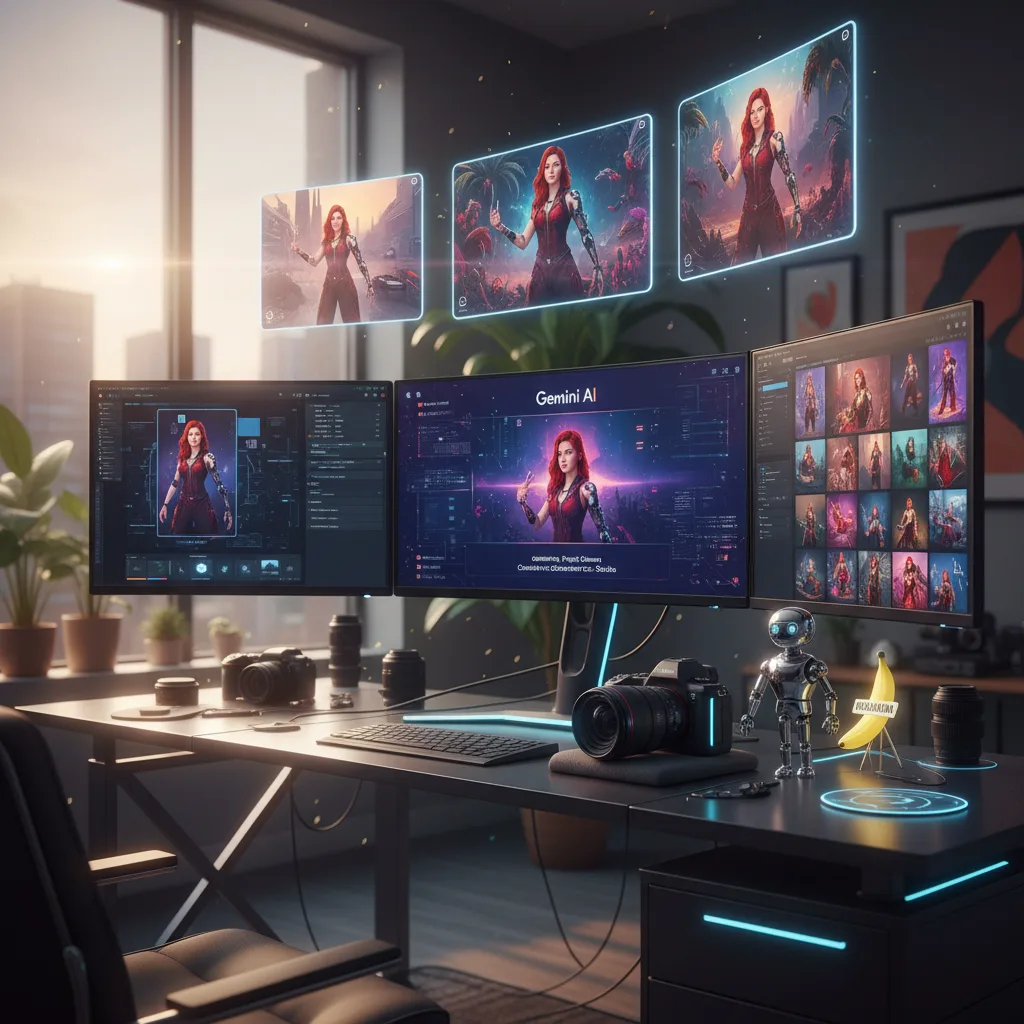
Perhaps the most impressive capability is maintaining character appearance across multiple prompts and edits. This addresses a fundamental pain point in AI image generation: the inability to preserve a subject’s identity between scenes. Gemini 2.5 Flash Image lets you place the same character in different environments, showcase products from multiple angles, or generate consistent brand assets without the subject morphing unpredictably.
Google demonstrates this with a template app that generates consistent characters for storytelling. The model preserves facial features, clothing details, and body proportions even when backgrounds, lighting, and poses change dramatically. For content creators building narrative series or brands maintaining visual identity, this feature alone justifies experimentation.
Natural Language Editing
Forget complex inpainting masks or technical parameters. Gemini enables targeted transformations using simple conversational prompts. You can blur backgrounds, remove stains from clothing, delete unwanted people from photos, alter subject poses, or colorize black-and-white images with commands like “remove the power lines” or “change her jacket to blue.”
This prompt-based editing works impressively fast—often completing in seconds—and understands context well enough to avoid destroying the underlying image structure. However, there’s an important caveat: these are regenerations, not pixel-perfect edits. The model creates a new image that approximates your request while preserving most original elements, which means subtle details may shift.
Multi-Image Fusion
The model can intelligently merge multiple input images into cohesive scenes. Upload a product photo and a background environment, then prompt “place this sofa in a modern living room with natural lighting.” The system handles perspective, lighting matching, and shadow generation automatically.
This capability extends to style transfer, texture application, and scene composition. Real estate marketers could generate consistent property listings, while e-commerce teams could create dynamic product mockups across entire catalogs from single templates.
World Knowledge Integration
Unlike pure diffusion models that operate without semantic understanding, Gemini 2.5 Flash Image leverages Google’s vast knowledge graph. This enables more accurate representations of real-world concepts, historical contexts, and technical specifications. The model can read hand-drawn diagrams, answer questions about visual content, and follow complex multi-step editing instructions that require conceptual understanding.
Real-World Performance: The Good and The Bad
Where Gemini Shines
In practical testing, Gemini 2.5 Flash Image demonstrates several clear strengths:
Speed and Reliability The model generates images quickly with minimal errors. Unlike earlier Google Imagen 4 preview models (being deprecated November 30, 2025), which frequently returned vague failure messages, Gemini 2.5 Flash Image consistently produces results. Gemini 2.5 Flash Image and Gemini 3 Pro Image are now Google’s recommended models. The generation pipeline feels stable and production-ready.
Photographic Detail For landscapes, cityscapes, and product photography, the model delivers sharp, detailed results. A prompt for a “futuristic electric car at sunset” produced sleek reflective surfaces, accurate cityscape details, and proper lighting effects. The model understands photographic concepts like aperture, shutter speed, and composition when prompted.
Text Handling While not perfect, Gemini handles text in images better than many competitors. In a test requiring the text “the new Fuji GFX 100RF” on a camera image, Gemini rendered legible characters, though with occasional spelling errors like “Pleades” instead of “Pleiades” in astronomy examples.
Flexibility The ability to iteratively refine images through conversation proves genuinely useful. You can generate a base image, then ask for specific adjustments—“make the lighting warmer,” “add a person in the background,” “change the aspect ratio to 16:9”—without starting from scratch.
Critical Weaknesses
Despite improvements, several limitations prevent Gemini from leading the pack:
The “AI Look” Problem Images often appear over-processed, with heavy bokeh effects, oversaturated colors, and perfect lighting that screams artificial. Close-ups of people look retouched to perfection, lacking the natural imperfections that make photos feel authentic. When prompted to “make it more realistic,” the model struggles, producing only marginally less polished results. This aesthetic may work for commercial product shots but fails for documentary-style or candid photography.
Inconsistent Editing Precision While Google markets “targeted transformations,” the reality is less precise. Changing a jacket color often results in a completely new image with altered poses, camera angles, or background elements. In one test, a cat eating a popsicle maintained its identity when the popsicle color changed, but its ears and hat shifted subtly. For true pixel-level editing, traditional tools like Photoshop still reign supreme.
Object Counting Failures The model struggles with precise object quantities. A request for “6 astronomical objects” produced random assortments with duplicates and miscounts. This limitation frustrates users needing specific layouts or inventories.
Resolution Constraints Gemini 2.5 Flash Image remains a lower-resolution, speed-first model. If you need higher-resolution output for print or premium display work, you are pushed toward newer Gemini image variants rather than getting a simple “pay more for bigger output” ladder inside the same model.
Safety Restrictions Google’s conservative content policies block generation of famous people and restrict creative freedom compared to alternatives like Grok. While this reduces misuse, it also limits legitimate creative applications.
Pricing and Accessibility
Google’s public pricing is the strongest part of Gemini’s commercial story. On Vertex AI, Gemini 2.5 Flash Image is priced at $0.30 per 1M input tokens, $2.50 per 1M text output tokens, and $30 per 1M image output tokens. Flex/Batch cuts that to $0.15 per 1M input tokens, $1.25 per 1M text output tokens, and $15 per 1M image output tokens.
That means Gemini is easier to budget for API-heavy workloads than many rivals. Instead of guessing at bundled subscription value or reverse-engineering unofficial “cost per image” estimates, teams can model their spend directly from Google’s published rate card.
The free tier provides limited access through Google AI Studio, though with usage caps and data collection for product improvement. Paid tiers through Vertex AI offer higher rate limits and privacy guarantees.
The Competition: How It Stacks Up
Meta AI: The Photorealism King
In head-to-head comparisons, Meta AI’s photorealistic results have been described as “decidedly mixed.” One independent review (Janisheck.com, June 2025) rated its quality as “MEH,” noting inconsistent performance across categories. While sometimes producing natural lighting and authentic textures, results vary significantly. However, Meta lacks Gemini’s character consistency and conversational editing workflow.
ChatGPT (GPT-4o): The Creative Powerhouse
OpenAI’s GPT-4o excels at artistic interpretation and prompt adherence. It generates single images slowly but with impressive conceptual understanding. The model handles complex multi-step instructions better than Gemini and produces more stylized, creative results. For marketing campaigns requiring unique artistic direction, ChatGPT often outperforms Gemini’s more literal interpretations. The tradeoff is pricing clarity: OpenAI’s public image cost picture is now split across ChatGPT subscriptions, GPT-image token pricing, and legacy DALL-E references.
Midjourney: The Photographer’s Choice
Midjourney still captures what Luminous Landscape calls “the essence of photography” better than competitors. Its images exhibit more natural color grading, realistic lighting, and emotional depth. However, Midjourney’s Discord-based workflow feels clunky compared to Gemini’s API and studio interface, and it lacks the world knowledge integration for technical accuracy.
Who Should Use Gemini Image Generation?
Gemini 2.5 Flash Image fits best for:
- E-commerce teams needing consistent product visualizations across multiple scenes
- Content marketers producing serialized visual stories with recurring characters
- Developers building AI-powered creative tools who need reliable API access
- Educators creating interactive learning materials that combine diagrams and explanations
- Budget-conscious high-volume users requiring predictable per-image costs
Look elsewhere if you need:
- Pure photorealism without AI artifacts
- Precise pixel-level editing control
- High-resolution outputs beyond 1024px
- Minimal content restrictions
- Artistic interpretation over literal generation
Final Verdict
Gemini 2.5 Flash Image represents a significant step forward for Google’s AI imaging ambitions, delivering genuine innovation in character consistency and conversational editing at a competitive price. For developers and businesses building integrated AI workflows, its API stability and speed make it a compelling choice. However, the persistent “AI look,” editing imprecision, and resolution limitations prevent it from dethroning specialized competitors.
In 2025, Gemini Image Generation isn’t the best AI image generator at any single thing, but it’s good enough at many things to earn a place in a multi-tool creative stack. Think of it as a versatile utility player rather than a star performer. For Google ecosystem users and high-volume generators, it’s absolutely worth testing. For those seeking the highest quality photorealism or artistic expression, supplementing with Meta AI or Midjourney remains necessary.
The technology is clearly evolving rapidly, and Google’s aggressive pricing suggests they’re playing the long game. For now, Gemini 2.5 Flash Image is a worthy tool for specific workflows, but not the revolutionary leap that renders competitors obsolete. To see how it compares directly with other leading models, check out our GPT-4o vs Gemini 2.5 Flash comparison.