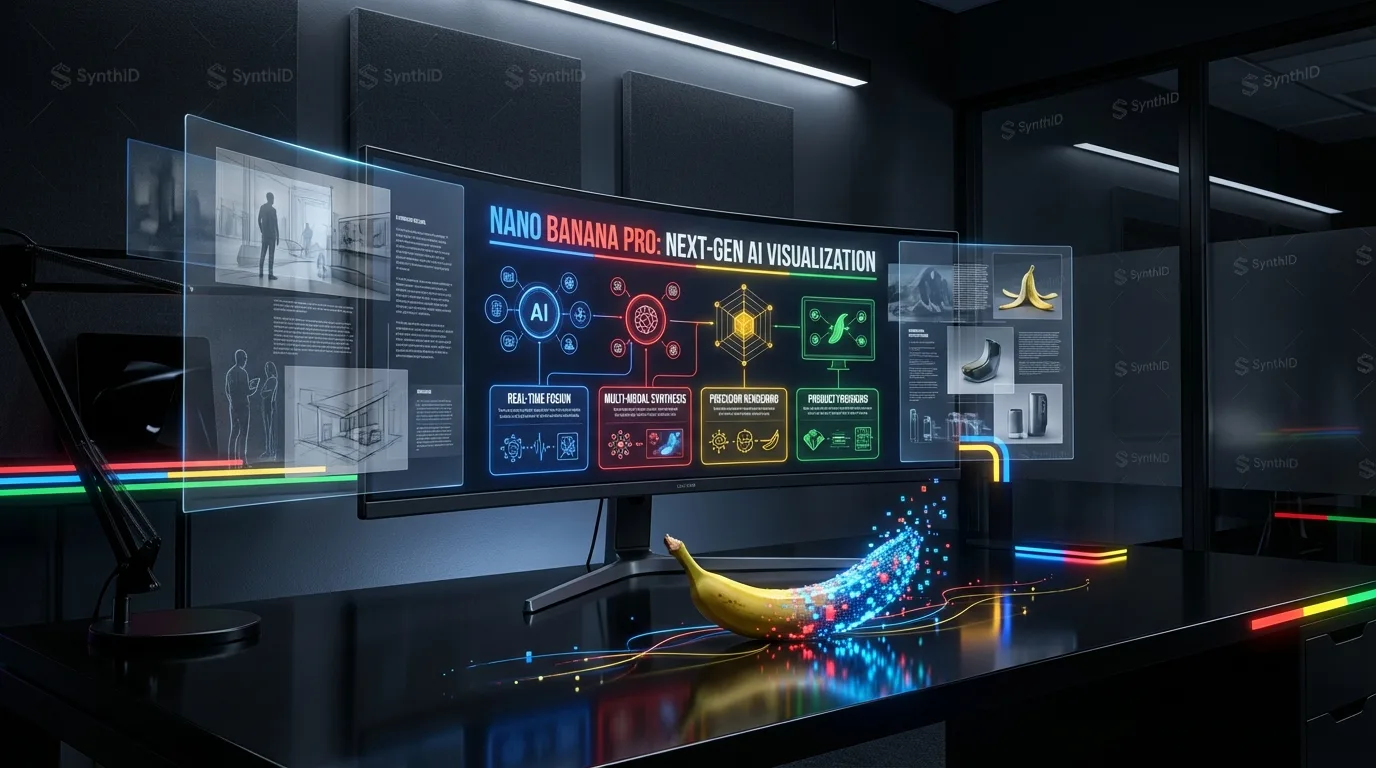


Google DeepMind has peeled back the curtain on its most sophisticated image generation model yet, and the timing couldn’t be more strategic. Just as competitors scramble to solve AI’s notorious text-rendering problem, Nano Banana Pro arrives with a promise that feels almost heretical: legible, accurate, multilingual text embedded directly into generated images—no workarounds required.
Built on the formidable reasoning engine of Gemini 3 Pro and released on November 20, 2025, Nano Banana Pro represents more than an incremental upgrade. It’s a fundamental rethinking of how AI models understand the relationship between visual elements and linguistic meaning. The model doesn’t just paint pixels; it reads, interprets, and contextualizes information before committing it to canvas.
The Architecture of Understanding
What separates Nano Banana Pro from its predecessor—and indeed, from most image generators on the market—is its integration with Gemini 3’s advanced reasoning capabilities. While earlier models treated text as visual texture, Nano Banana Pro approaches words as semantic units, understanding not just what letters look like, but what they mean.
This manifests in three critical technical advances:
- Grounded Generation: The model can tap into Google Search’s real-time knowledge base, pulling current weather data, stock charts, or recent events to create infographics that are not just visually compelling, but factually accurate
- Thinking Mode: Nano Banana Pro generates interim “thought images” behind the scenes, refining composition before delivering the final high-resolution output. These thought images are backend-only and not charged to users.
- Massive Context Window: With support for up to 14 reference images—including 6 objects and 5 human subjects—the model maintains consistency across complex, multi-element scenes that would fracture lesser systems
Capabilities That Matter
Text Rendering That Actually Works
The headline feature is impossible to ignore: Nano Banana Pro generates correctly spelled, properly formatted text in multiple languages across diverse typographic styles. From calligraphic flourishes that visually express word meanings to accurate translations on product packaging, the model handles everything from short taglines to full paragraphs.
Early testing shows it excels at:
- Infographic creation: Transform a simple photo of a houseplant into a comprehensive care guide with properly labeled diagrams
- Storyboarding: Convert a single scene description into a complete shot sequence with accurate camera angle notation
- Multilingual content: Localize marketing materials while preserving brand consistency and visual integrity
Multi-Image Composition Mastery
Where previous generators struggled to maintain identity when blending more than a few elements, Nano Banana Pro can juggle up to 14 inputs while preserving the distinct characteristics of up to five individuals. This isn’t just technical flexing—it opens practical workflows for:
- Fashion editorials combining multiple models into cohesive scenes
- Product visualization that maintains brand assets across variations
- Educational content that synthesizes disparate visual sources into unified diagrams
Studio-Grade Creative Control
Professional creators gain access to granular controls previously reserved for manual editing suites:
- Localized editing: Select, refine, and transform specific image regions without affecting the entire composition
- Cinematic adjustments: Modify camera angles, depth of field, and focal points
- Lighting sculpting: Transform day to night, apply chiaroscuro effects, or create custom bokeh
- Resolution flexibility: Output at 1K, 2K, or 4K (5632 × 3072 pixels) for any platform requirement
The Ecosystem Play
Google isn’t launching a standalone tool—it’s deploying a cross-platform creative layer. Nano Banana Pro is rolling out across:
- Gemini App: Available in “Thinking” mode with tiered usage limits
- Google Workspace: Slides, Vids, and NotebookLM integration for Business and Enterprise customers
- Google Ads: Upgraded creative tools for advertisers globally
- Developer Platforms: Gemini API, AI Studio, and Vertex AI access for enterprise scaling
- Flow: AI filmmaking tool for Google AI Pro and Ultra subscribers (with Veo 2 for Pro, higher limits and Veo 3 for Ultra)
This ubiquity matters. While competitors offer powerful generators as standalone products, Google is weaving Nano Banana Pro into the productivity fabric millions already use daily.
The Demand Problem
Here’s where the narrative takes a pragmatic turn. The model’s capabilities have triggered immediate resource constraints. Free tier users now face a two-image daily limit—reduced from three just days after launch—while Google AI Pro and Ultra subscribers retain their 100 and 500 prompt quotas respectively.
API pricing reflects the computational intensity: $0.24 per 4K image and $0.134 for 1K/2K outputs. Image inputs cost $0.00011 each, making complex multi-reference scenes a calculated investment rather than a casual experiment.
This demand crunch isn’t unique to Google—OpenAI faced similar challenges with its DALL-E integration—but it underscores a growing tension between democratizing access and managing infrastructure costs for state-of-the-art models.
Transparency in the Synthetic Age
All Nano Banana Pro outputs carry Google’s imperceptible SynthID watermark, and the company is putting verification tools directly in users’ hands. Upload any image to the Gemini app and ask if it was AI-generated; the system will detect SynthID markers even in edited or cropped versions.
Free and Pro tier images display a visible Gemini sparkle watermark, while Ultra subscribers and AI Studio users receive clean outputs for professional work. This tiered approach acknowledges that transparency and creative flexibility exist on a spectrum, not a binary.
The Bottom Line
Nano Banana Pro doesn’t just incrementally improve AI image generation—it addresses the medium’s most persistent failure modes while introducing capabilities that feel genuinely new. The text rendering alone solves problems that have plagued the field since its inception, and the multi-image consistency opens workflows previously impossible without manual compositing.
The catch is access. At two free images per day, casual users get little more than a taste, while professionals face API costs that demand clear ROI justification. But for those who can clear the bar—advertisers, educators, content creators, and developers—Nano Banana Pro currently stands as the most capable, controllable image generation system commercially available.
Google has essentially built the Ferrari of image generators: breathtaking performance, precise handling, and a price tag that reflects its capabilities. The question isn’t whether it’s the best tool in the category—early consensus suggests it is—but whether the market is ready to pay premium prices for premium results.
The answer, judging by the immediate throttling of free access, appears to be a resounding yes.
The featured image for this article was generated using nano banana 3 pro, demonstrating the model’s ability to create compelling visuals with accurate text integration.