

Midjourney’s Style Creator: The Evolution of Prompt Engineering
Midjourney just executed the most elegant pivot in AI creative tools: it offers a visual alternative to typing words. The company’s early-release Style Creator fundamentally reimagines how humans collaborate with generative AI by offering visual manipulation as an alternative to text prompts—a move that doesn’t just simplify the process, but potentially reduces reliance on complex prompt engineering.
What Is Style Creator?
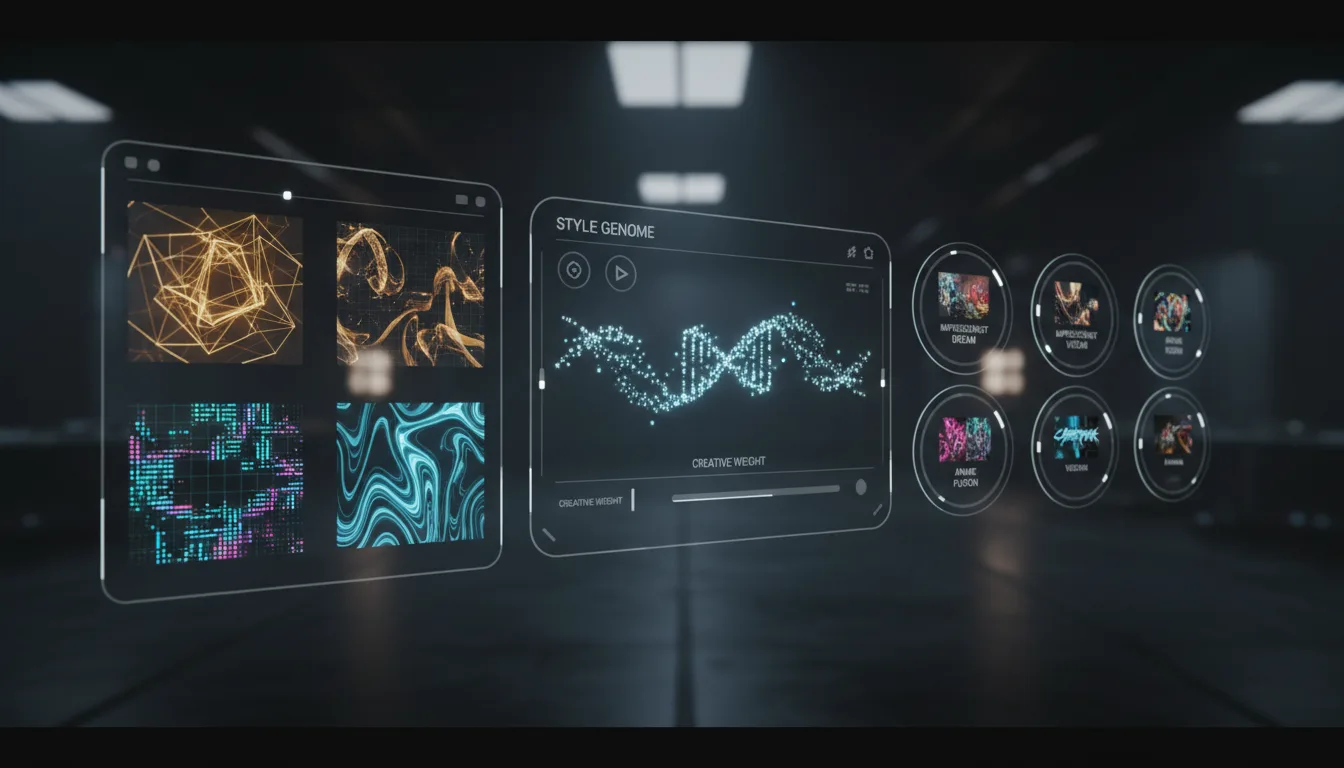
Style Creator is Midjourney’s new interface for building custom aesthetic codes (--sref) through pure visual selection. Rather than typing “cinematic lighting, golden hour, in the style of 1970s Kodachrome,” users construct their desired aesthetic by selecting from visual options: color palettes, compositional styles, textural qualities, and atmospheric elements. The system builds on Midjourney’s existing SREF library, allowing users to refine and combine established visual styles into custom codes. While prompts remain optional, the visual interface provides an alternative path to style creation.
The system interprets these visual choices in real-time, building a unique “visual DNA” that can be applied to any subsequent generation. It’s mood board meets machine learning—an intuitive, iterative process that mirrors how traditional artists actually work.
The Prompt Problem No One Solved—Until Now
Since emerging around 2022, the AI art community has been trapped in a linguistic arms race. Mastering Midjourney required fluency in an arcane vocabulary: “volumetric lighting,” “chromatic aberration,” “synthwave aesthetic.” Professional artists with art history degrees consistently outperformed visual thinkers who lacked verbal precision.
This created three critical barriers:
- Accessibility walls: Non-native English speakers and visually-dominant thinkers were systematically disadvantaged
- Cognitive load: Users spent 30+ minutes engineering the “perfect prompt” instead of exploring creatively
- Language bias: Text prompts inherit cultural baggage—“professional” skews male and Western, “beautiful” carries racial and gendered assumptions
Style Creator offers a way around these limitations. Instead of only describing what you want, you can demonstrate it visually.
How It Actually Works
While Midjourney has released minimal technical documentation, the workflow is elegantly simple:
- Visual Onboarding: Users are presented with arrays of stylistic choices—abstract compositions, color relationships, lighting scenarios
- Iterative Refinement: Each selection narrows the aesthetic space, with the system generating live previews of how choices combine
- Code Generation: The final style is saved as a reusable
--srefcode that encapsulates your visual preferences - Seamless Application: Apply your custom style to any prompt (with or without additional text prompts) for consistent aesthetic output
The key breakthrough is the feedback loop. Instead of generating blind and adjusting text, you see your style emerge visually, tuning it through direct manipulation.
Why This Changes Everything
The implications extend far beyond convenience:
Democratization Accelerates
- Visual thinkers now have equal footing with verbal thinkers
- Language barriers evaporate—your aesthetic isn’t limited by vocabulary
- The skill curve flattens dramatically; visual judgment matters more than technical jargon
Creative Process Transforms
- Exploration becomes iterative and tactile, not analytical
- Discovery happens through doing, not planning
- The gap between vision and execution collapses
Bias Mitigation
- Visual selection sidesteps linguistic stereotypes embedded in training data
- “Professional,” “beautiful,” and “artistic” become what you show, not what the model assumes
Industry Evolution
- The prompt engineering cottage industry (courses, consultants, template marketplaces) may see reduced demand
- Competitive advantage may shift from articulation to curation and taste
The Broader Pattern: AI’s Invisible Interface
Midjourney’s move fits a decisive trend in AI development: the best interfaces are the ones that disappear. We’re witnessing the same evolution that took us from command lines to graphical interfaces to touchscreens.
- ChatGPT’s voice mode now integrates directly into chat with real-time text display and visual elements, replacing the separate mode with a seamless multimodal experience
- Google’s NotebookLM eliminated manual context-loading
- AI video tools now accept sketches and reference footage instead of descriptions
Text prompts were always a compromise—a translation layer between human intent and machine understanding. Style Creator suggests we’re finally building tools that learn our language, whether that’s visual, gestural, or conceptual.
This shift is particularly significant when considering how AI image generators have evolved. While tools like DALL-E 3 still rely heavily on text prompts, Midjourney’s visual approach represents a fundamental paradigm shift that could influence the entire industry.
The Verdict: Welcome to the New Era of Multimodal Creation
Midjourney’s Style Creator is more than a feature update; it’s a declaration of intent. While still in early release, the company is betting that the future of generative AI includes more intuitive ways to express intent beyond language alone.
For professionals, this means faster iteration, more authentic creative expression, and access to talent previously blocked by technical barriers. For the industry, it sets a new standard: tools that rely solely on text prompts may soon feel limited.
The irony is exquisite. We built Large Language Models to understand text at unprecedented depth, and now that capability is making text optional. This evolution toward visual interfaces won’t just be more accessible—it will be visually stunning.