Meta SAM 3D Transforms 2D Photos into Walkable 3D Scenes
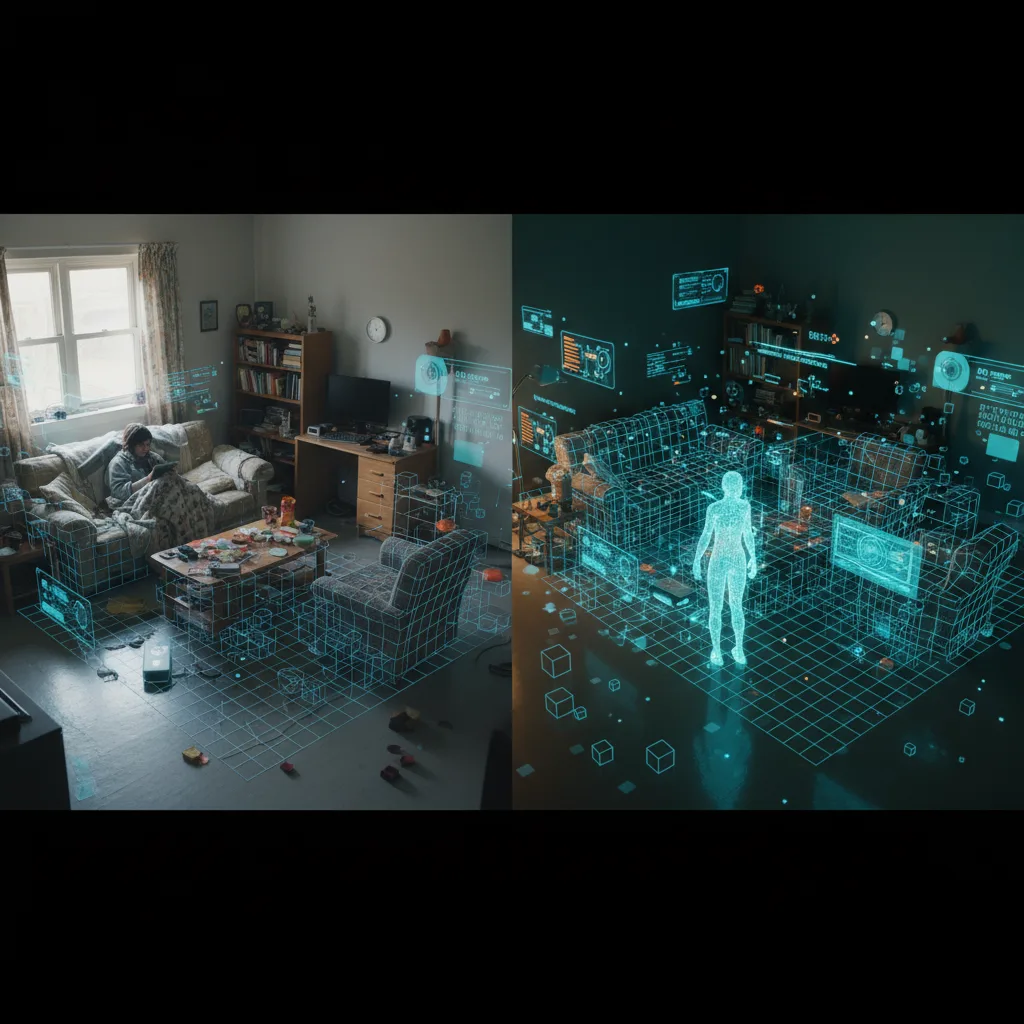
Meta has unveiled SAM 3D, a groundbreaking addition to its Segment Anything family that converts ordinary 2D photographs into fully explorable 3D environments. The release introduces two specialized foundation models—SAM 3D Objects for scene reconstruction and SAM 3D Body for human shape estimation—that deliver state-of-the-art performance by leveraging a novel training approach that overcomes the historic scarcity of 3D training data.
Available immediately through the new Segment Anything Playground, SAM 3D represents a significant leap toward AI systems that understand physical space with human-like common sense. The technology is already powering a new “View in Room” feature on Facebook Marketplace, marking one of the first mass-market applications of single-image 3D reconstruction.
Two Specialized Models Power the System
SAM 3D comprises distinct but complementary models optimized for different reconstruction tasks:
SAM 3D Objects: Scene Reconstruction
SAM 3D Objects reconstructs complete 3D assets—including shape, texture, and spatial layout—from single natural images. The model excels in challenging real-world conditions where objects are partially occluded, viewed indirectly, or surrounded by clutter. Unlike previous systems limited to synthetic or staged settings, SAM 3D Objects handles everyday photographs with remarkable robustness.
Key capabilities include:
- Dense scene reconstruction with multiple objects in realistic layouts
- Sub-second processing through diffusion shortcuts and model distillation
- Dual output formats: polygon meshes and Gaussian splats for flexible use cases
- Camera-relative pose estimation enabling free viewpoint rendering
In head-to-head human preference tests, SAM 3D Objects achieved at least a 5:1 win rate against leading existing methods.
SAM 3D Body: Human Mesh Recovery
SAM 3D Body addresses the challenge of accurate 3D human pose and shape estimation from a single image, even with unusual postures, occlusions, or multiple people. The model introduces several innovations:
- Promptable architecture accepting segmentation masks and 2D keypoints for interactive control
- Meta Momentum Human Rig (MHR), a new open-source parametric mesh format that decouples skeletal structure from soft tissue shape
- Full-body reconstruction including detailed hand and foot poses
- Robustness across diverse clothing, viewpoints, and capture conditions
The model was trained on approximately 8 million high-quality images selected through an automated data engine that prioritized unusual poses and rare conditions.
Architecture: How It Works
SAM 3D Objects employs a sophisticated two-stage transformer architecture that balances efficiency with detail:
Stage 1: Geometry Prediction
- 1.2B-parameter flow transformer using Mixture-of-Transformers (MoT) architecture
- Processes both cropped object views and full-image context via DINOv2 feature extraction
- Predicts coarse 32³ voxel representation and camera pose (rotation, translation, scale)
- Structured attention masks ensure shape and layout consistency
Stage 2: Texture & Refinement
- 600M-parameter sparse latent flow transformer
- Operates only on occupied voxels for computational efficiency
- Improved Depth-VAE prevents texture bleeding into occluded regions
- Generates high-resolution geometry and realistic surface textures
The system supports optional depth inputs from LiDAR or monocular estimation, further improving layout accuracy. Both mesh and Gaussian splat decoders share a common latent space, ensuring consistent outputs across formats.
Training Breakthrough: Overcoming the 3D Data Barrier
The most significant innovation in SAM 3D is its training methodology, which solves the critical data scarcity problem that has historically limited 3D AI.
Multi-Stage Pipeline
1. Pre-training (Synthetic)
- Trained on Objaverse-XL dataset of isolated 3D assets
- Learns fundamental shape and texture prediction skills
- Provides strong foundation but limited to clean, simple scenes
2. Mid-Training (Semi-Synthetic)
- “Render-Paste” technique composites synthetic objects into real images
- Teaches mask-following, occlusion robustness, and layout estimation
- Bridges the simulation-to-reality gap
3. Post-Training (Real-World Alignment) Human-in-the-loop data engine iteratively:
- Generates candidate 3D reconstructions
- Routes examples to annotators for ranking/selection
- Sends hardest cases to expert 3D artists
- Updates model based on human preferences
This process annotated nearly 1 million distinct images, generating 3.14 million model-in-the-loop meshes—an unprecedented scale for 3D reconstruction.
Preference Alignment
After supervised fine-tuning on real data, the model undergoes Direct Preference Optimization (DPO) using annotator comparisons, followed by distillation to reduce inference steps from 25 to 4, enabling near real-time performance.
Performance and Benchmarks
Meta collaborated with 3D artists to create the SAM 3D Artist Objects (SA-3DAO) dataset, a rigorous evaluation benchmark featuring diverse real-world images paired with high-quality mesh annotations. This dataset surpasses existing benchmarks in realism and challenge, pushing the field toward physical world perception rather than synthetic tests.
Results demonstrate:
- 5:1 human preference win rate over competing methods
- Sub-second inference for full textured reconstructions
- Robust generalization across object categories and scene complexities
- State-of-the-art accuracy on multiple 3D human reconstruction benchmarks
Immediate Applications
Facebook Marketplace Integration
SAM 3D and SAM 3 already power the new “View in Room” feature, allowing shoppers to visualize home decor items in their actual spaces before purchasing. This represents Meta’s first product deployment of the technology at scale.
Creative and Professional Tools
The technology enables:
- Game asset generation from reference photos
- AR/VR content creation without manual 3D modeling
- Robotics perception modules for real-time scene understanding
- Sports medicine analysis through accurate body pose estimation
- Film pre-visualization and virtual production workflows
Accessibility
The Segment Anything Playground provides a no-code interface for anyone to experiment with SAM 3D capabilities using their own images, democratizing access to advanced 3D reconstruction.
Current Limitations
While groundbreaking, SAM 3D has clear areas for improvement:
- Moderate output resolution limits detail on complex objects
- Single-object prediction without joint reasoning about physical interactions between objects
- No multi-person interaction modeling in SAM 3D Body
- Hand pose accuracy, while improved, doesn’t yet match specialized hand-only methods
Meta’s researchers note these as natural next steps for development.
How to Access SAM 3D
Researchers, developers, and creators can start experimenting immediately:
- Segment Anything Playground: Interactive demo at aidemos.meta.com/segment-anything
- Model Checkpoints & Code: Available on GitHub for SAM 3D Objects and SAM 3D Body
- MHR Model: Open-source parametric human model released under permissive commercial license
- Research Papers: Full technical details available on the Meta AI website
Verdict: A Paradigm Shift in 3D AI
SAM 3D represents more than an incremental improvement—it fundamentally redefines how AI systems learn to understand three-dimensional space. By cracking the 3D data annotation bottleneck through intelligent human-model collaboration and a sophisticated multi-stage training recipe, Meta has created a system that brings common-sense spatial reasoning to natural images.
The immediate product integration in Facebook Marketplace demonstrates commercial viability, while the open-source release of models, code, and benchmarks will accelerate research across robotics, AR/VR, and creative industries. For creators, the ability to generate production-ready 3D assets from a single photograph removes a major barrier to 3D content creation. Similar to how Tencent Hunyuan 3D revolutionized AI-powered 3D asset generation, SAM 3D’s approach offers a blueprint for scaling other data-starved modalities.
While resolution and interaction modeling limitations remain, SAM 3D establishes a new foundation for physically-grounded AI perception—one that could prove as influential for spatial computing as the original Segment Anything Model was for computer vision. As the field of AI image generation continues to evolve, SAM 3D’s breakthrough in 3D reconstruction represents a natural progression toward more comprehensive spatial understanding in AI systems.