Krea 2 Is Now Downloadable in Two Different Forms
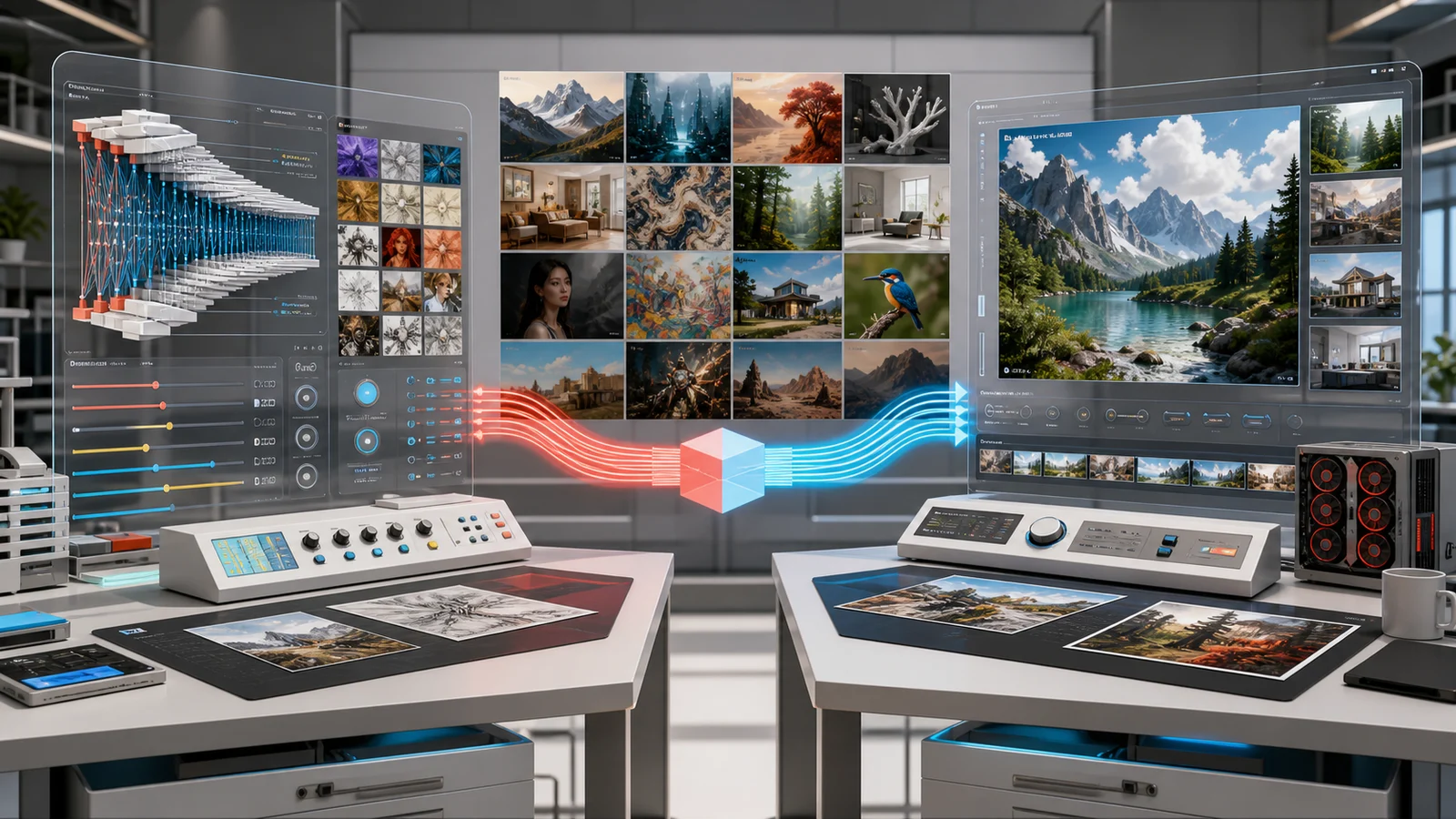
Krea has released the weights and inference code for Krea 2, its first image foundation-model family trained from scratch. The release is split into two checkpoints with deliberately different jobs:
- Krea 2 Raw is the malleable base checkpoint for fine-tuning, post-training, and LoRA training.
- Krea 2 Turbo is the distilled checkpoint for fast, polished text-to-image inference.
Krea’s simplest guidance is also the right way to understand the release: train on Raw, run on Turbo.
The weights are available through Krea’s Hugging Face organization, while the official GitHub repository includes inference code and recommended settings. That turns Krea 2 from a hosted product feature into a model developers can run, tune, and integrate into their own workflows.
Krea 2 Raw vs Turbo
| Krea 2 Raw | Krea 2 Turbo | |
|---|---|---|
| Primary job | Fine-tuning and research | Fast image generation |
| Training state | Base checkpoint before extra post-training and distillation | Post-trained and distilled checkpoint |
| Recommended steps | 52 | 8 |
| Guidance | CFG 3.5 | CFG disabled |
| Recommended resolution | Up to roughly 1K | Roughly 1K to 2K |
| Best fit | LoRAs, domain adaptation, post-training | Local or hosted production inference |
The Raw checkpoint can generate images, but Krea explicitly says it is not the recommended inference path. Its value is that it has not been compressed into the narrower behavior needed for fast few-step generation.
Turbo is the practical generation model. The official recipe uses eight steps,
no classifier-free guidance, and a resolution-dependent timestep shift. Krea’s
Hugging Face card also exposes the model through the Krea2Pipeline in
Diffusers, with official examples for SGLang.
What Is Under the Hood
Krea describes the open release as a 12-billion-parameter diffusion transformer with:
- a Qwen Image VAE
- a Qwen3-VL text encoder
- multi-layer text-feature aggregation
- grouped-query attention with gated sigmoid attention
- a single-stream transformer design
The company says its core objective was broad aesthetic coverage rather than a single polished default look. Its technical report details a multi-stage training pipeline spanning pretraining, mid-training, supervised fine-tuning, preference optimization, and reinforcement learning.
Krea also says it filtered AI-generated images out of the pretraining mix. The published model cards, however, describe the broader model-development data as a combination of public, licensed, and proprietary synthetic data. That wording deserves careful reading: the technical report’s no-synthetic claim is specific to the pretraining mix, not necessarily every later stage.
Open Weights Does Not Mean No-Strings-Attached
Krea markets the release as open source, but developers should evaluate it as an open-weights model under a custom community license.
The Krea 2 Community License allows use, modification, derivatives, and distribution subject to its conditions. Commercial use under that community license is limited to entities with less than $1 million in company-wide annual revenue, measured over the trailing 12 months. A company that reaches or exceeds the threshold needs a separate enterprise license before commercial use.
The license also includes distribution and naming requirements. Deployers must retain the agreement and attribution, and derivative model names must begin with “Krea.” The terms prohibit various harmful and illegal uses.
This is not merely paperwork. The model cards say downstream deployers must implement content filtering or an equivalent review process appropriate to their use case. Krea applies classifiers to its hosted product, but it cannot provide that layer automatically when another team deploys the weights.
Before using Krea 2 commercially, read the current license rather than relying on the phrase “open source” in a headline.
The Raw-to-Turbo LoRA Workflow Is the Main Idea
The most interesting design choice is not just releasing a slow model and a fast model. Krea designed them to share customization work.
A team can train a LoRA against Raw, where the model remains more adaptable, then apply that LoRA to Turbo for much faster inference. Krea already publishes style LoRAs built around that workflow.
That separation could be useful for:
- brand and campaign style adaptation
- product photography domains
- architecture and interior visualization
- illustration and editorial style systems
- private post-training experiments
The practical test is transfer quality. Teams should verify that a LoRA trained on Raw preserves the intended style and subject behavior when moved to Turbo, rather than assuming every fine-tune will transfer perfectly.
Where You Can Run It
The official release points to several paths:
- Hugging Face for Raw and Turbo weights
- the official Python inference repository
- Diffusers through
Krea2Pipeline - SGLang for serving
- ComfyUI workflows
- hosted access through services including fal
Krea does not publish one universal consumer-hardware requirement on the release page. A 12B image transformer is still a substantial local workload, and the right hardware depends on precision, quantization, resolution, and runtime. Treat “consumer hardware” as a deployment direction to test, not as a promise that every laptop or GPU will run the full checkpoint comfortably.
What This Changes for Krea
Our current Krea AI review positions Krea as a broad creative workspace rather than a single image model. The open release adds a second product story: Krea can now be both the hosted workspace and the source of a model that developers control directly.
That also changes the comparison with closed platforms. Our Midjourney vs Krea comparison focuses on workflow and output trade-offs. Open weights give Krea another advantage for teams that need private deployment, domain tuning, or integration outside a vendor UI.
It does not settle image quality. Krea cites strong leaderboard results, but rankings move and Krea’s own release materials reference different snapshots. Independent testing across typography, photorealism, prompt adherence, LoRA transfer, and local performance will matter more than one launch-day rank.
Our Take
Krea made the correct release design. Raw preserves a useful training base; Turbo provides the fast checkpoint people will actually generate with. The shared LoRA path gives the pair a coherent purpose instead of making them two unrelated downloads.
The license is the main caveat. Small teams and individual creators receive a meaningful commercial path, but larger companies need enterprise terms and all deployers inherit safety responsibilities.
For creators already using Krea, nothing requires an immediate switch to local inference. For developers, model trainers, and teams that need more control than the hosted app provides, Krea 2 Raw and Turbo are a serious new option worth benchmarking against FLUX and other open-weight image families.