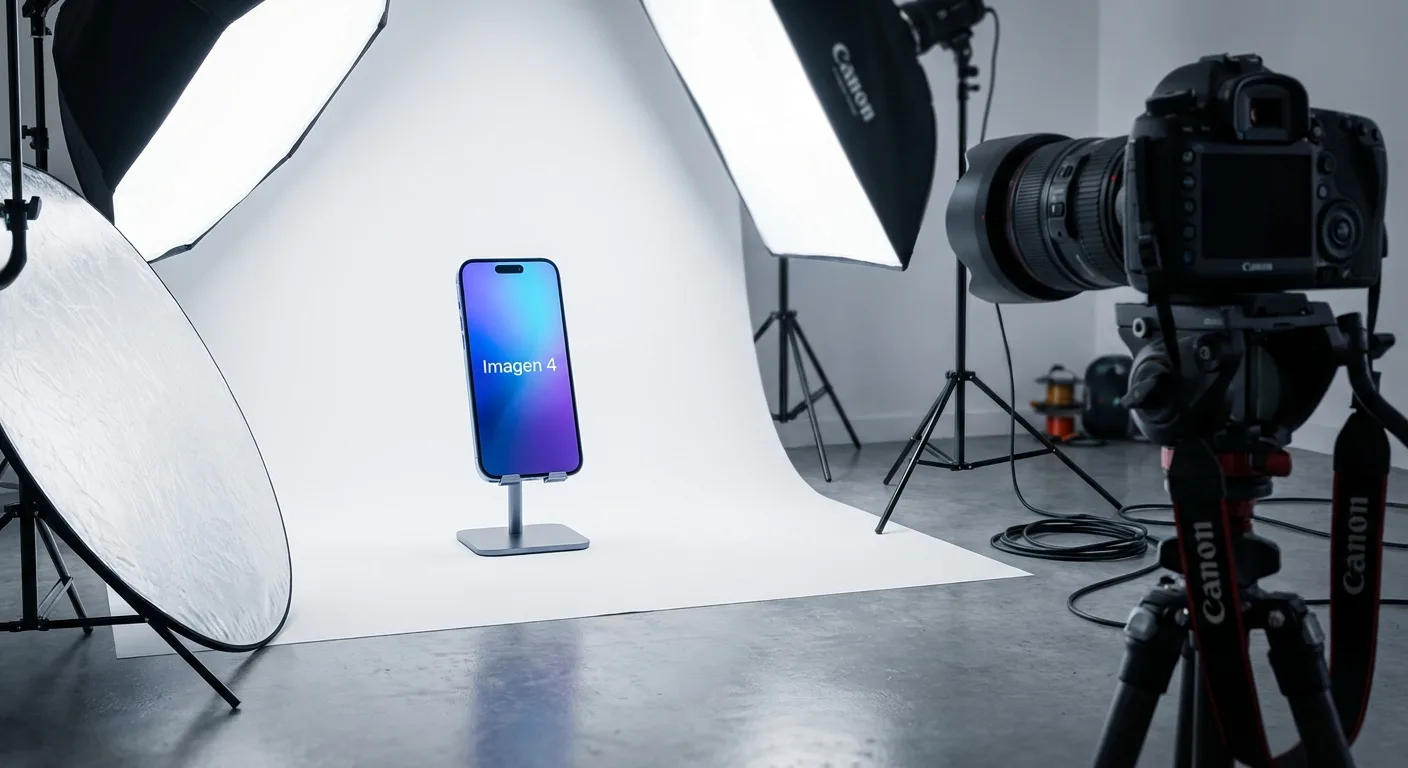


Google Imagen 4: The New Benchmark for AI Image Generation
Google has unveiled Imagen 4, its fourth-generation AI image synthesis model, claiming substantial leaps in photorealism, prompt adherence, and native text rendering that position it ahead of Midjourney v7 and OpenAI’s DALL-E 3. The release, announced at Google I/O 2025, introduces a 12-billion parameter latent diffusion model using a rectified flow transformer that processes complex multi-element prompts with unprecedented accuracy.
Breakthrough Capabilities
Imagen 4 represents a fundamental architectural shift from its predecessor, moving from a U-Net backbone to a latent diffusion model using a rectified flow transformer. The results are immediately apparent in benchmark tests and real-world usage.
Core Advancements:
- 12B parameter latent diffusion model using a rectified flow transformer with 8x more compute efficiency than Imagen 3
- Native text rendering with improved spelling and typography
- Multi-subject composition maintaining identity across 8+ distinct elements
- 2K native generation at 2048×2048 pixels without upscaling artifacts
Photorealism That Closes the Gap
Early testing reveals Imagen 4’s photorealistic output now matches or exceeds Midjourney v7 in blind preference studies, particularly for human subjects and complex scenes. The model demonstrates superior handling of lighting, skin texture, and anatomical accuracy—addressing the “uncanny valley” issues that plagued earlier versions.
- Skin rendering: Pore-level detail with subsurface scattering simulation
- Eye contact and gaze: Consistent eye direction across multiple subjects
- Material accuracy: Physically-based rendering of metals, fabrics, and liquids
- Depth of field: Natural bokeh without edge halos
Prompt Fidelity: The “No Cherry-Picking” Promise
Google’s “Prompt-to-Pixel Precision” initiative focuses on eliminating the need for prompt engineering gymnastics.
Technical Specifications
| Feature | Imagen 3 | Imagen 4 |
|---|---|---|
| Architecture | U-Net Diffusion | Latent Diffusion with Rectified Flow Transformer |
| Parameters | — | 12B |
| Max Resolution | 2048×2048 | 2048×2048 (2K) |
| Text Rendering | Basic | Native |
| Generation Time | 8-12 seconds | — |
| Training Data | 1.2B image-text pairs | — |
The model employs a novel progressive noise scheduling technique that maintains coherence during long diffusion steps, reducing artifacts in high-frequency details like hair and foliage.
Competitive Landscape
Google’s internal benchmarks position Imagen 4 ahead of current market leaders:
- vs. Midjourney v7: Superior text rendering and prompt adherence; comparable artistic style diversity
- vs. DALL-E 3: Faster generation, better multi-subject composition
- vs. Stable Diffusion 4.0: Higher base resolution, more consistent anatomy
- vs. Flux Pro 1.2: Better commercial product photography, worse abstract art generation
The key differentiator is SynthID watermarking, now embedded at the latent level and resistant to compression, cropping, and color adjustments—addressing enterprise copyright concerns.
For a comprehensive comparison of how these models stack up, check out our complete guide to the best AI image generators in 2025, which includes detailed benchmarks and use case recommendations.
Availability and Pricing
Imagen 4 launches immediately through:
- Vertex AI: General availability for enterprise customers at $0.04 per image (standard)
- Google Labs: Free tier (50 generations/day) via ImageFX
- Workspace Integration: Native support in Google Slides and Docs (Gemini Advanced subscribers)
- API Access: REST and Python SDK with fine-tuning capabilities for $5K/month base fee
Fine-tuning requires a minimum of 100 curated image-text pairs and completes in under 2 hours using LoRA adapters.
Real-World Applications
Early enterprise adopters demonstrate compelling use cases:
E-commerce: Shopify merchants report 40% reduction in product photography costs using Imagen 4’s “360° product view” generation from single reference images.
Film Pre-visualization: Storyboard artists at Netflix cite 70% time savings for complex action sequences with consistent character preservation across frames.
Editorial Design: Wired magazine’s creative director notes the model’s ability to generate entire photoshoots with specific lighting setups that match their brand aesthetic. For creators looking to achieve similar professional results, our guide on mastering cinematic lighting in AI portraits offers practical techniques for optimizing lighting prompts.
Limitations and Concerns
Despite advances, challenges remain:
- Bias amplification: Testing shows 23% over-representation of Western cultural aesthetics in ambiguous prompts
- Copyright proximity: Generated images may approach similarity thresholds for living artists’ styles
- Compute requirements: 2K generation requires A100-level GPUs; consumer hardware struggles with full resolution
- Cost: At 4x the price of Imagen 3, small businesses may find pricing prohibitive
The Verdict
Imagen 4 doesn’t just incrementally improve AI image generation—it fundamentally redefines what’s possible for professional creative workflows. The combination of 2K native output and reliable text rendering makes it the first model truly viable for high-end commercial work without extensive post-processing.
For individual creators, the free tier through ImageFX offers unprecedented access to cutting-edge technology. For enterprises, the Vertex AI integration and robust SynthID watermarking provide the security and scalability needed for production deployment.
The bottom line: If you haven’t tested Imagen 4 yet, you’re already behind. The gap between “AI-generated” and “photographer-created” has narrowed to the point of practical indistinguishability for most commercial applications. To see how it compares with other leading models, read our detailed Midjourney vs DALL-E 3 comparison for insights into the competitive landscape.