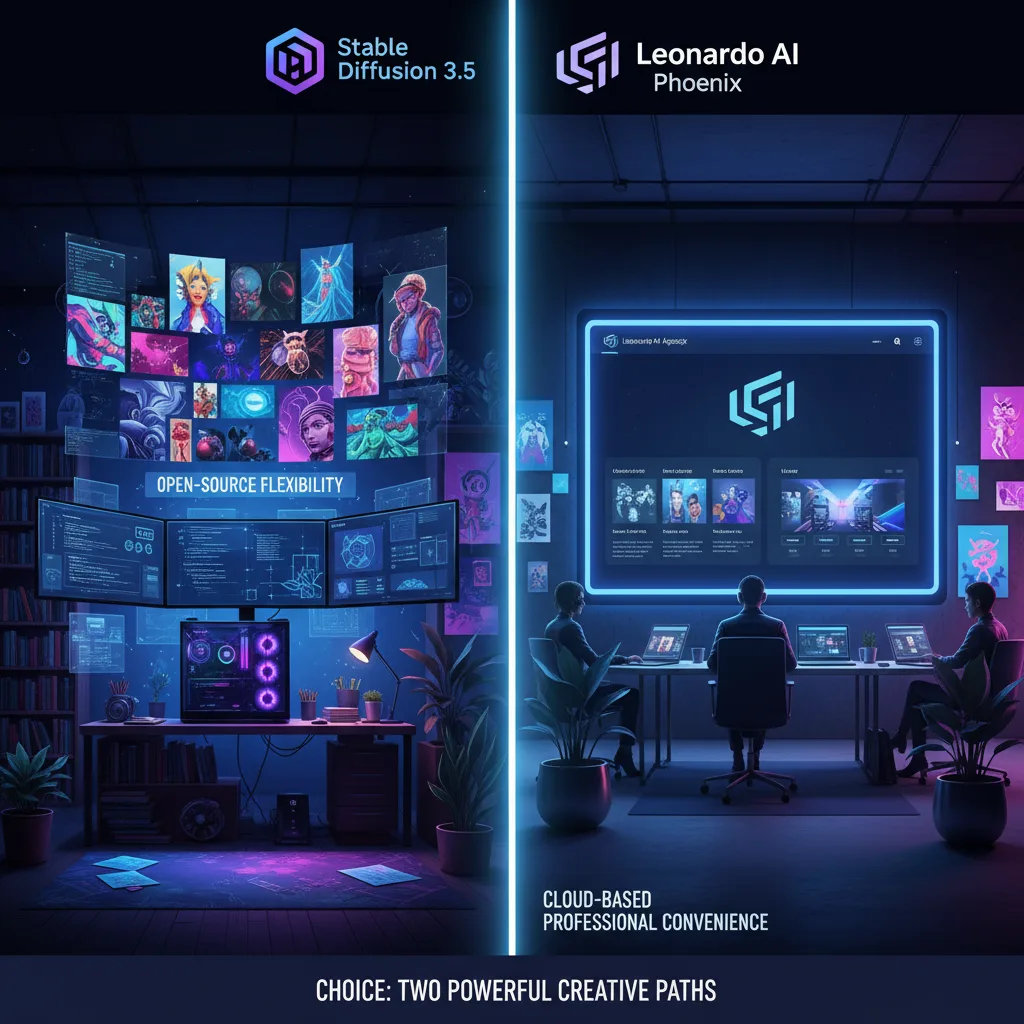




leonardo wins this comparison
The AI image generation landscape has matured dramatically, with two distinct philosophies now dominating the market. On one side stands Stable Diffusion 3.5 (SD 3.5), Stability AI’s open-source powerhouse that prioritizes flexibility and accessibility. On the other, Leonardo AI Phoenix, a proprietary cloud platform engineered for professional creative workflows. Both released in late 2024, these tools represent the cutting edge of generative AI—but they serve fundamentally different audiences.
This head-to-head comparison examines how these platforms stack up across critical dimensions, helping you determine which solution deserves a place in your creative toolkit.
Overview: Two Paths to AI-Generated Imagery
Stable Diffusion 3.5: The Democratization Engine
Released in late October 2024, SD 3.5 embodies Stability AI’s commitment to open-source AI. Available in three distinct variants—Large (8.1 billion parameters), Large Turbo (distilled for speed), and Medium (2.5 billion parameters)—the model runs locally on consumer hardware and remains free for commercial use under $1 million in annual revenue.
The architecture introduces query-key normalization for more stable training and fine-tuning, while intentionally preserving output diversity to maintain a broader knowledge base. SD 3.5 generates images up to 1 megapixel natively, with the Medium variant supporting resolutions up to 2MP.
Leonardo AI Phoenix: The Professional’s Workstation
Leonardo’s Phoenix model, launched in June 2024, represents a different approach: a proprietary, cloud-hosted solution built for immediate professional application. Phoenix prioritizes photorealism, text rendering accuracy, and prompt adherence, delivering consistent results through an intuitive web interface.
The platform has evolved rapidly, adding Style Reference and Image-to-Image capabilities in October 2024, followed by Motion 2.0 video generation in May 2025. Leonardo positions itself as a complete creative suite rather than a standalone model, integrating AI Canvas editing, custom model training, and specialized asset generation tools.
Feature Comparison: Customization vs. Convenience
| Feature | Stable Diffusion 3.5 | Leonardo AI Phoenix |
|---|---|---|
| Text Rendering | Excellent (significantly improved from 3.0) | Market-leading (core architectural strength) |
| Prompt Adherence | Top-tier, market-leading per Stability AI analysis | Excellent, highly consistent |
| Style Versatility | Extensive: 3D, photography, painting, line art, anime | Strong: Photorealism focus with specialized models |
| Resolution | Up to 1MP (Large/Turbo); 0.25-2MP (Medium) | Plan-dependent, up to high-resolution outputs |
| Generation Speed | 4 steps (Turbo); hardware-dependent (Large) | 10-30 seconds typical (cloud-consistent) |
| Customization | Unlimited (open-source architecture) | Platform-limited but streamlined |
| Local Execution | Yes (complete privacy control) | No (cloud-only) |
| ControlNet Support | Coming soon (officially announced) | Integrated with Image Guidance features |
| Video Generation | Via third-party extensions | Native Motion 2.0 (May 2025) |
| Custom Model Training | Unlimited (Dreambooth, LoRA, textual inversion) | Streamlined in-platform training (up to 50 models) |
Advanced Capabilities
Stable Diffusion 3.5’s open architecture unlocks integration with thousands of community models via Civitai and Hugging Face. Users can combine it with ESRGAN for upscaling, regional prompters for precise control, and custom pipelines for specialized workflows. The upcoming ControlNet support will further enhance compositional control.
Leonardo AI Phoenix counters with purpose-built professional tools. The AI Canvas enables real-time iterative editing, while specialized models cater to game development (RPG assets, textures), architectural visualization, and anime production. The Style Reference feature allows visual style transfer from reference images, and Motion 2.0 converts still images into 4-second video clips. Character Reference—now available—enables consistent character generation across multiple images.
Quality Comparison: Raw Power vs. Refined Output
Image Quality & Prompt Adherence
Both platforms deliver exceptional results, but their strengths diverge.
Stable Diffusion 3.5 Large produces images that rival models several times its size, with market-leading prompt adherence that accurately translates complex, multi-element descriptions. The model intentionally generates varied representations from identical prompts—a design choice that preserves creative diversity but may frustrate users seeking absolute consistency. The Large Turbo variant maintains impressive quality despite its 4-step generation process, while the Medium model strikes an optimal balance between quality and hardware efficiency.
Leonardo AI Phoenix excels at photorealism and—most notably—text rendering within images. Users consistently praise its ability to generate readable, correctly spelled text in logos, posters, and advertisements. The output quality remains remarkably consistent, making it ideal for client work where predictability matters. Phoenix’s AI-assisted prompt engineering helps non-technical users achieve professional results without extensive parameter tuning.
Generation Speed & Performance
Speed comparisons depend entirely on hardware for SD 3.5. On an RTX 4090, SD 3.5 Large generates images in seconds; on modest GPUs, it may take minutes. The Turbo variant delivers near-instant results, while the Medium model optimizes for consumer hardware requiring just 9.9GB VRAM.
Leonardo’s cloud infrastructure ensures consistent 10-30 second generation times regardless of user hardware. Premium subscription tiers receive priority processing, reducing wait times further. This hardware independence proves invaluable for teams collaborating across diverse devices or creators working on laptops.
Pricing: Total Cost of Ownership
Stable Diffusion 3.5: Free to Start, Hardware to Scale
Self-Hosted (Free Tier)
- License Cost: $0 (free for commercial use under $1M annual revenue)
- Hardware Investment: $500–$2,000+ for a suitable GPU (8GB+ VRAM minimum; 12GB+ recommended)
- Marginal Cost: $0 per generation after initial investment
- Enterprise Licensing: Required for organizations exceeding $1M revenue (contact Stability AI)
API Pricing (Effective August 1, 2025)
- SD 3.5 Large: $0.208 per API call
- SD 3.5 Large Turbo: $0.128 per call
- SD 3.5 Medium: $0.112 per call
- Credit system: 1 credit = $0.01
Third-Party Platforms: Variable pricing on Replicate, ComfyUI, and AWS Marketplace
Bottom Line: SD 3.5 becomes cost-effective at high volumes but requires significant upfront investment and technical expertise.
Leonardo AI Phoenix: Predictable Subscription Model
| Plan | Monthly Cost | Annual Cost | Monthly Fast Tokens | Key Limitations |
|---|---|---|---|---|
| Free | $0 | $0 | ~4,500 (150/day) | Public generations, watermarked videos, limited features |
| Apprentice | $12 | $10/mo | 8,500 | 10 custom models, 1 concurrent job |
| Artisan | $30 | $24/mo | 25,000 | 20 custom models, 3 concurrent jobs |
| Maestro | $60 | $48/mo | 60,000 | 50 custom models, 6 concurrent jobs |
Token Consumption:
- Basic image: 5–8 tokens
- Image upscale: 5–10 tokens
- Motion 2.0 video (4s): ~200 tokens
- Veo 3 video (8s):
2,500 tokens ($1.25 at Artisan tier pricing)
API Access: Separate pricing starting at $9/month for 3,500 credits
Bottom Line: Leonardo offers a generous free tier for experimentation, with predictable costs scaling linearly with usage. The subscription model eliminates hardware concerns but becomes expensive for high-volume production.
Use Cases: Matching Tools to Workflows
When to Choose Stable Diffusion 3.5
- Research & Academia: Open architecture enables algorithm modification and reproducible studies
- High-Volume Production: Generate thousands of images at zero marginal cost
- Privacy-Sensitive Projects: Local execution ensures data never leaves your hardware
- Custom Application Development: Embeddable in proprietary software and automated pipelines
- Experimental Art: Unlimited fine-tuning and community model exploration
- Enterprise Deployments: Complete infrastructure control and predictable licensing
- Specialized Genres: Access thousands of niche models (anime, medical imaging, architectural styles)
- Budget-Conscious Startups: Free commercial use accelerates early-stage development
When to Choose Leonardo AI Phoenix
- Professional Creative Agencies: Deliver client work with consistent quality and speed
- Game Development: Specialized models for RPG assets, character design, and texture generation
- Marketing & Advertising: Superior text rendering for logos, posters, and branded content
- Iterative Design Workflows: AI Canvas enables real-time brainstorming and refinement
- Small Teams: Predictable costs and zero IT overhead
- Motion Graphics: Integrated Motion 2.0 video generation without external tools
- Non-Technical Artists: Intuitive interface eliminates learning curve
- Remote Collaboration: Cloud-based platform ensures consistent access across devices
Verdict: Leonardo AI Phoenix Wins on Overall Value
After evaluating both platforms across quality, speed, pricing, and usability, Leonardo AI Phoenix emerges as the winner for overall value—particularly for professional creatives and teams.
Why Leonardo Wins:
Professional Polish: Phoenix delivers consistent, client-ready results without parameter tuning or workflow experimentation. The platform’s specialized tools—AI Canvas, Style Reference, and Motion 2.0—address real creative needs rather than technical possibilities.
Predictable Economics: While SD 3.5 appears “free,” the true cost includes hardware investment, setup time, and ongoing maintenance. Leonardo’s subscription model provides cost certainty and eliminates technical overhead, letting creators focus on creation rather than infrastructure.
Accessibility: Leonardo’s generous free tier (150 daily tokens) enables serious experimentation, while paid tiers scale affordably. SD 3.5’s hardware requirements create a barrier to entry that many individual creators cannot overcome.
Integrated Workflow: Phoenix’s all-in-one approach—combining generation, editing, custom training, and video creation—streamlines production pipelines that would require multiple tools with SD 3.5.
Stable Diffusion 3.5’s Rightful Domains:
SD 3.5 remains the undisputed champion for technical users, high-volume production, and privacy-sensitive applications. If you need to generate 10,000 images daily, embed AI in a proprietary application, or maintain absolute data control, SD 3.5’s open architecture and zero marginal cost are unbeatable.
For researchers, developers, and enterprises with dedicated technical staff, SD 3.5 offers unlimited potential. For everyone else, Leonardo AI Phoenix provides better immediate value.
The Bottom Line: Choose Leonardo AI Phoenix for professional creative work and team collaboration. Choose Stable Diffusion 3.5 for technical flexibility, high-volume automation, and privacy-critical applications. Most creative professionals will find Leonardo’s convenience worth the subscription cost.
For more insights on choosing the right AI image generator for your needs, check out our comprehensive guide to the best AI image generators in 2025. If you’re interested in how these tools compare to other leading platforms, see our comparison of Midjourney V7 vs Leonardo Phoenix or explore how Flux vs Stable Diffusion 3.5 stack up in performance.