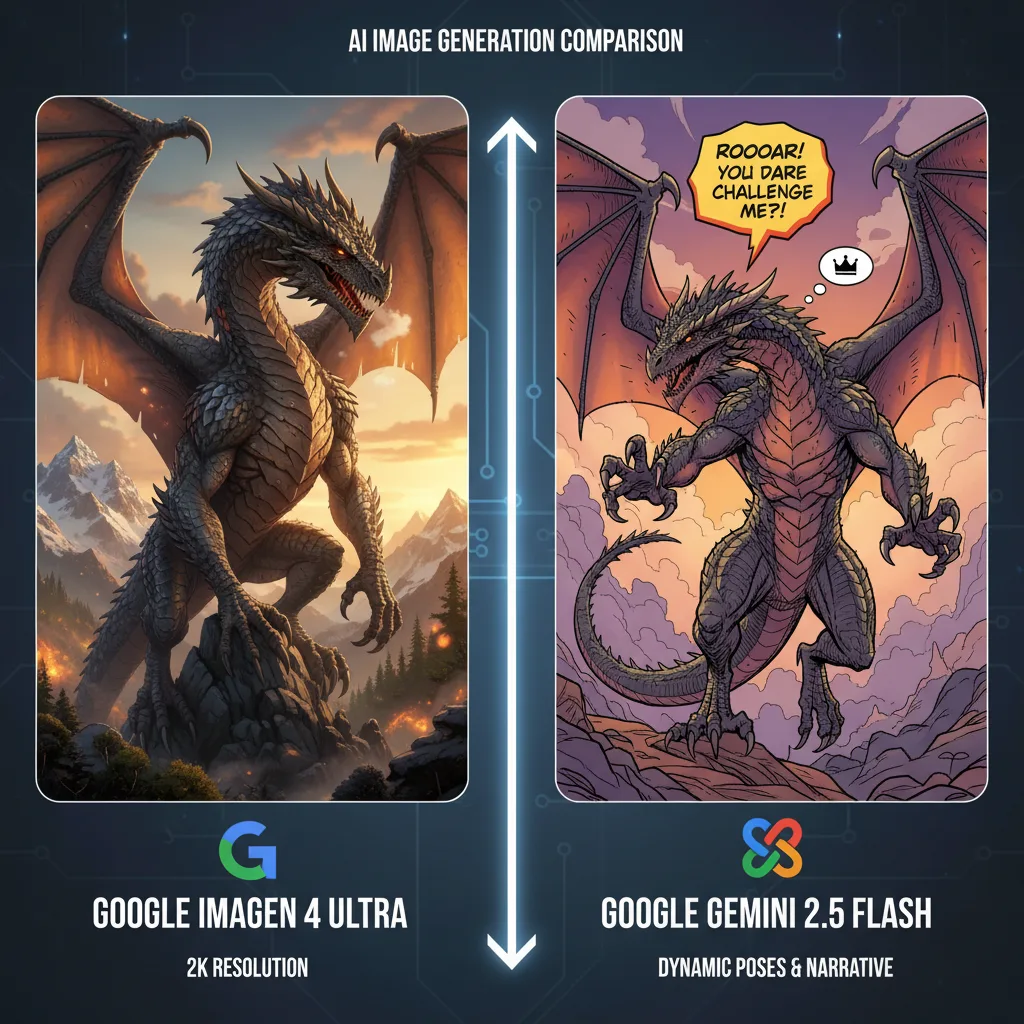




gemini-image wins this comparison
Google now fields two distinct powerhouses in AI image generation: Imagen 4, the photorealistic specialist, and Gemini 2.5 Flash Image, the versatile speed demon. Both launched in August 2025, but they serve fundamentally different creative needs. This comparison breaks down where each model excels, where they stumble, and which one deserves your workflow integration.
Overview: Two Models, Two Philosophies
Imagen 4 (General Availability: August 14, 2025) represents Google’s push for production-ready visual fidelity. Available in three tiers—Fast, Standard, and Ultra—it prioritizes texture detail, accurate text rendering, and high-resolution output up to 2K. Deep integration with Google Workspace makes it the corporate choice for Docs, Slides, and Vids.
Gemini 2.5 Flash Image (Launch: August 26, 2025), codenamed “Nano Banana,” takes a radically different approach. (Production-ready October 2, 2025; superseded by Nano Banana Pro in November 2025) Built for speed and interactivity, it generates images in 3-4 seconds while offering multi-image blending, character consistency, and natural language editing capabilities. It’s less about perfect pixels and more about creative agility.
Both models embed SynthID watermarks mandatorily and share access through the Gemini API, Vertex AI, and Google AI Studio, but their architectural differences create a clear fork in the road for users.
Feature Comparison: Capabilities at a Glance
| Feature | Imagen 4 | Gemini 2.5 Flash Image |
|---|---|---|
| Max Resolution | Up to 2K (2048×2048) | 1024×1024 pixels |
| Generation Speed | 3-5 sec (Fast), 8-12 sec (Standard/Ultra) | 3-4 seconds |
| Text Rendering | Excellent—accurate typography, long-form text | Good—still developing complex text |
| Multi-Image Input | No | Yes—blend and merge multiple images |
| Image Editing | No native editing | Yes—targeted local edits, object removal, pose alteration |
| Character Consistency | No | Yes—maintains appearance across prompts |
| Conversational Interface | Limited | Full dialogue-based refinement |
| Workspace Integration | Direct embedding in Docs, Slides, Vids | Limited |
| Pricing | $0.02–$0.06 per image (tiered) | $0.039 per image (flat) |
| Free Tier | ~50 images/day | Limited free access (production-ready) |
Key Takeaway: Imagen 4 is a specialized image factory; Gemini 2.5 Flash is a creative collaborator.
Quality Comparison: Pixels vs Possibilities
Photorealism and Detail
Imagen 4 Ultra sets the benchmark for visual fidelity. Fabric textures, water droplets, animal fur, and architectural details render with exceptional sharpness. The model’s latent diffusion architecture produces cleaner outputs with stricter prompt adherence than its predecessor. For product photography, architectural visualizations, and marketing materials requiring pixel-perfect realism, Imagen 4 Ultra delivers production-ready assets.
Gemini 2.5 Flash generates strong, coherent images but doesn’t match Imagen 4’s textural depth. Its 1024×1024 resolution cap also limits fine detail. However, it compensates with world knowledge from Gemini’s semantic understanding, producing more contextually nuanced scenes—useful for storytelling and conceptual work where literal accuracy matters less than narrative coherence.
Text Rendering
This is Imagen 4’s clearest win. The model handles long-form text, complex typography, and multi-line layouts with remarkable accuracy. Signage, poster designs, and UI mockups with embedded text emerge cleanly legible. Google explicitly targeted this weakness from Imagen 3, and the improvement shows.
Gemini 2.5 Flash acknowledges text rendering as “in development.” Short labels and simple phrases work adequately, but longer copy often suffers from character-level artifacts. For text-heavy designs, Imagen 4 is the only reliable choice.
Prompt Adherence and Style Control
Imagen 4 follows prompts literally and precisely. Specify “golden hour lighting from a 35mm lens at f/1.8” and the model delivers that technical direction accurately. This makes it ideal for photographers and designers with exacting specifications.
Gemini 2.5 Flash interprets prompts more loosely, using Gemini’s conversational intelligence to infer intent. This can be frustrating for literalists but liberating for explorers. Its template adherence feature excels at matching visual styles across generations, crucial for brand consistency.
Pricing: The Value Equation
Imagen 4 Tiered Structure
- Imagen 4 Fast: $0.02/image—best for rapid ideation and internal drafts
- Imagen 4 Standard: $0.04/image—professional quality for client presentations
- Imagen 4 Ultra: $0.06/image—premium tier for final production assets
Third-party platforms like laozhang.ai offer discounts down to $0.012/image, though with potential latency trade-offs.
Gemini 2.5 Flash Flat Rate
At $0.039 per image (1,290 output tokens at $30 per million), Gemini positions itself between Imagen 4 Standard and Ultra. There’s no tiered quality ladder—every generation runs at maximum capability.
Scale Economics: For 10,000 monthly images, Gemini costs $390. Imagen 4 Standard hits $400, while Ultra reaches $600. The difference becomes significant at enterprise volume.
Free Access: Imagen 4 offers ~50 daily images through Google AI Studio. Gemini’s production availability includes limited free generations, though quotas are less transparent.
Use Cases: Matching Tool to Task
When to Use Imagen 4
- Professional Marketing Materials: High-resolution product shots, campaign visuals, and brand assets where quality justifies cost
- Architectural Visualization: 2K resolution captures fine structural details and material textures
- Text-Heavy Designs: Posters, signage, UI mockups requiring accurate typography
- Final Production Renders: When assets go directly to print or publication without revision cycles
- Google Workspace Integration: Embedding images directly into Docs, Slides, or Vids streamlines collaborative workflows
When to Use Gemini 2.5 Flash
- Interactive Applications: Real-time image generation for chatbots, games, or dynamic content
- Rapid Prototyping: 3-4 second generations enable fast iteration during brainstorming sessions
- Storytelling & Comics: Character consistency maintains protagonist appearance across panels and scenes
- Image Editing Workflows: Natural language instructions like “blur background, change dress to red, add sunset lighting” eliminate manual Photoshop work
- Multi-Image Composition: Blending reference images, style guides, and subject photos into cohesive outputs
Verdict: Gemini 2.5 Flash Wins on Overall Value
Declaring a winner requires acknowledging that these tools serve different masters. However, for overall value—balancing capability, versatility, and cost—Gemini 2.5 Flash Image takes the crown.
Why Gemini Wins
-
Functional Breadth: Editing, multi-image fusion, and character consistency aren’t just features—they’re entirely new workflows impossible with Imagen 4. This transforms image generation from a one-shot task into an iterative creative process.
-
Speed Advantage: At 3-4 seconds, Gemini matches Imagen 4 Fast’s speed while delivering quality comparable to Imagen 4 Standard. For creative exploration, this velocity compounds productivity gains.
-
Conversational Interface: The ability to refine images through dialogue reduces friction. Instead of crafting perfect prompts, users can say “make the lighting warmer” and iterate naturally.
-
Cost Transparency: Flat pricing simplifies budgeting. Imagen 4’s tiered structure forces quality-versus-cost decisions on every generation.
Where Imagen 4 Still Reigns
For pure quality and text rendering, Imagen 4 Ultra remains unmatched. If your work demands photorealistic perfection—fashion photography, luxury product renders, or print advertising—the $0.06 price premium delivers tangible ROI. The 2K resolution advantage also matters for large-format applications.
The Bottom Line
- Choose Gemini 2.5 Flash if you value speed, editing flexibility, and multi-image workflows. It’s the better tool for most creative professionals, marketers, and application developers.
- Choose Imagen 4 if you need maximum photorealism, accurate text rendering, or direct Workspace integration. It’s the specialist for high-stakes visual production.
For readers exploring deeper capabilities, our dedicated pillar pages cover each model exhaustively: Imagen 4 for photorealistic mastery and Gemini Image Generation for interactive creativity. Those considering alternatives should also explore our comprehensive comparison of Midjourney V7 vs Google Imagen 4 and our guide to the best AI image generators in 2025.