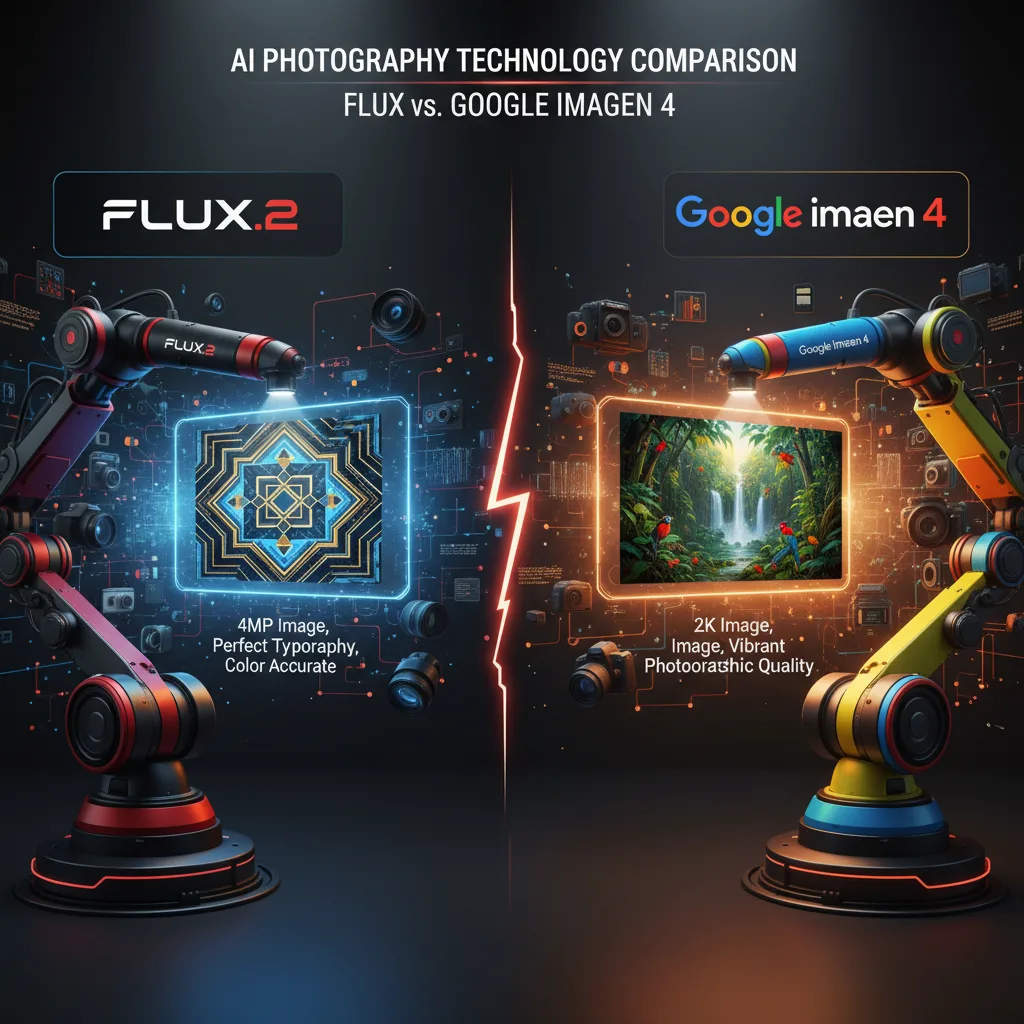



flux wins this comparison
The AI image generation landscape has fundamentally shifted with the arrival of Black Forest Labs’ FLUX.2, challenging Google’s established dominance in the space. Released on November 25, 2025, FLUX.2 arrives just six months after Google DeepMind’s Imagen 4 debuted on May 20, 2025, bringing a disruptive combination of higher resolution, lower cost, and open-source flexibility that directly confronts Google’s enterprise-focused approach.
Both models represent the cutting edge of generative AI, yet they embody contrasting philosophies. FLUX.2 prioritizes accessibility and raw performance, while Imagen 4 leverages Google’s infrastructure and proven reliability. For creative professionals, developers, and enterprises evaluating these tools, the choice hinges on specific workflow requirements, budget constraints, and ecosystem preferences.
Overview: Two Paths to AI Image Generation
FLUX.2 emerges from Black Forest Labs, a team with deep roots in open-source AI development. The model family includes four distinct variants: the production-ready FLUX.2 [pro] at $0.03 per image, the flexible FLUX.2 [flex] for custom quality-speed tradeoffs, the open-weight FLUX.2 [dev] with 32 billion parameters, and the upcoming FLUX.2 [klein] for resource-constrained environments. This tiered approach democratizes access while maintaining commercial viability.
Imagen 4, developed by Google DeepMind, builds upon the solid foundation of its predecessor with three pricing tiers: Standard ($0.04/image) for balanced performance, Fast ($0.02/image) for rapid iteration, and Ultra ($0.06/image) for maximum quality. As part of the Google ecosystem, it integrates seamlessly with Vertex AI and Gemini API, offering a frictionless experience for existing Google Cloud customers.
Feature Comparison: Capability Showdown
The technical specifications reveal stark differences in approach and capability:
-
Maximum Resolution: FLUX.2 delivers native 4MP (approximately 2,048 x 2,048 pixels) outputs, while Imagen 4 caps at 2K resolution, giving FLUX.2 a decisive advantage for print and high-fidelity digital applications.
-
Multi-Reference Generation: FLUX.2 [flex] supports up to 10 simultaneous reference images (with [dev] and [pro] supporting up to 8) for consistent character and style maintenance across generations—a feature completely absent in Imagen 4, which limits users to single-image reference.
-
Generation Speed: FLUX.2 produces images in under 10 seconds consistently. Imagen 4’s Standard tier offers balanced generation times, while its Fast tier provides significantly quicker generation at the cost of some quality fidelity.
-
Prompt Capacity: FLUX.2 accepts up to 32,000 tokens, enabling extremely detailed prompt engineering. Imagen 4 restricts input to 480 tokens, requiring more concise prompting strategies.
-
Watermark Policy: FLUX.2 outputs contain no mandatory watermarks, while all Imagen 4 generations include Google’s SynthID watermarking system—a potential dealbreaker for commercial production work.
-
Text Rendering: FLUX.2 demonstrates superior typography handling and can match hex color codes precisely, making it ideal for logo creation and marketing materials. Imagen 4 improved text rendering over Imagen 3 but still trails FLUX.2’s capabilities.
-
Control Mechanisms: FLUX.2 offers direct pose control and advanced editing features within a unified architecture, whereas Imagen 4 relies on traditional latent diffusion with separate editing pipelines.
Quality Comparison: Pixel-Perfect Performance
In practical testing, FLUX.2’s 4MP resolution provides noticeably sharper details, especially in complex scenes with fine textures like fabric, foliage, or architectural elements. The model’s latent flow matching architecture, combined with a Mistral-3 24B parameter vision-language model, produces images with exceptional coherence and adherence to complex prompts.
Imagen 4, while limited to 2K resolution, maintains Google’s reputation for photorealistic quality and improved prompt adherence over its predecessor. The Ultra tier particularly excels at natural lighting and material accuracy, though it cannot overcome the fundamental resolution gap.
Text generation quality strongly favors FLUX.2. The model renders crisp, legible typography at any size, accurately reproduces brand colors via hex codes, and handles multi-line text layouts without the garbling issues that still occasionally plague Imagen 4. For designers creating mockups, social media graphics, or advertising materials, this capability alone justifies FLUX.2 adoption.
Both models handle human anatomy and facial features well, though FLUX.2’s multi-reference capability gives it a commanding lead for projects requiring consistent characters across multiple scenes—a critical feature for storytelling, comic creation, and branded content campaigns.
Pricing: The Cost Equation
At scale, pricing differences become substantial. Generating 10,000 images monthly costs approximately $3,600 annually with FLUX.2 [pro] versus $4,800 for Imagen 4 Standard—a 25% savings that compounds for high-volume users.
Imagen 4 Fast at $0.02/image undercuts FLUX.2 on per-unit cost but sacrifices quality and features. The Ultra tier at $0.06/image positions itself as a premium option, yet still cannot match FLUX.2’s resolution or multi-reference capabilities.
Imagen 4’s free tier through Google AI Studio provides valuable testing opportunities, while FLUX.2’s open-source [dev] variant allows unlimited local generation for non-commercial use. Developers can experiment with FLUX.2 [dev] at no cost, though commercial deployment requires a separate license.
For bootstrapped startups and independent creators, FLUX.2’s cost advantage opens doors that Imagen 4’s pricing structure keeps closed. Enterprise customers with existing Google Cloud commitments may find Imagen 4’s integration worth the premium.
Use Cases: Matching Tools to Tasks
Choose FLUX.2 when you need:
- High-resolution outputs for print, large-format displays, or detailed digital assets
- Consistent character or product styling across hundreds of generations
- Complex typography and precise color matching
- Cost-effective batch processing at scale
- Open-source deployment flexibility
- Native editing capabilities without switching tools
Choose Imagen 4 when you need:
- Enterprise-grade reliability and Google Cloud integration
- Rapid ideation with the Fast tier’s significantly quicker generation
- A proven track record with extensive third-party tooling
- Vertex AI pipeline integration for existing workflows
- The safety net of Google’s infrastructure and support
- Access to a free tier for prototyping and learning
Verdict: FLUX.2 Wins on Overall Value
After evaluating both models across quality, speed, pricing, and ecosystem integration, FLUX.2 emerges as the winner for overall value. Its combination of 4MP resolution, multi-reference generation, superior text rendering, and aggressive pricing represents a generational leap that Imagen 4 cannot currently match.
The absence of mandatory watermarks, larger prompt capacity, and open-source options make FLUX.2 the more versatile and creator-friendly choice. For production artists, marketing teams, and developers building AI-native applications, FLUX.2’s feature set directly addresses common pain points while delivering state-of-the-art quality at a lower cost.
However, this victory comes with important caveats. Imagen 4 remains the pragmatic choice for organizations deeply embedded in Google’s ecosystem. The Fast tier’s exceptional speed-to-cost ratio serves rapid prototyping needs, and the free tier lowers barriers for newcomers. Enterprises prioritizing proven reliability over cutting-edge features will find Imagen 4’s track record compelling.
The decision ultimately depends on your priorities: choose FLUX.2 for maximum capability and value, or Imagen 4 for enterprise integration and proven stability. For most creative and commercial applications, FLUX.2’s technical advantages and cost savings make it the smarter investment. To explore more AI image generation options, check out our comprehensive guide to the best AI image generators in 2025, or see how these models compare against other leading tools like Midjourney in our detailed Midjourney V7 vs Flux 2 comparison.